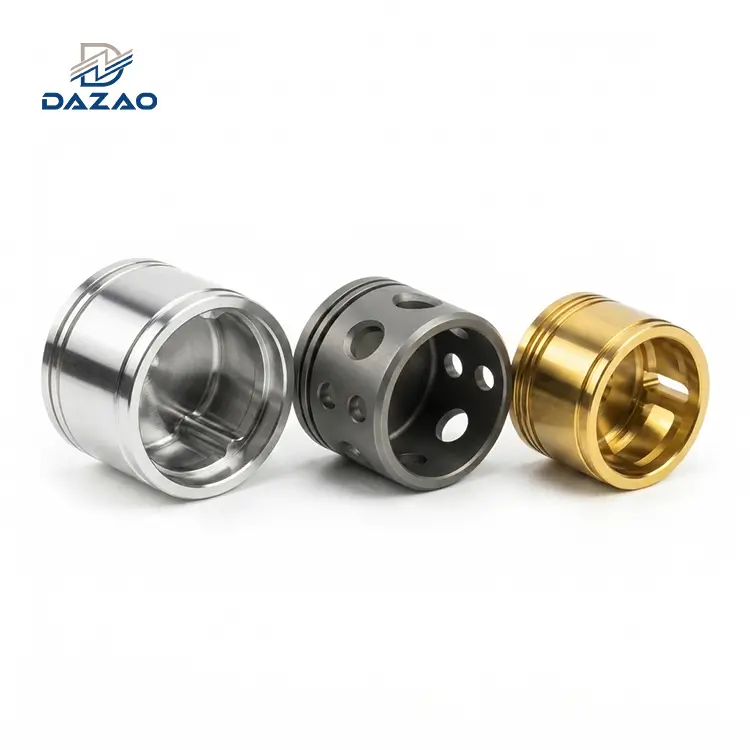

Selecting between aluminum vs titanium for CNC machining requires balancing yield strength against machining feed rates. While Ti-6Al-4V (Grade 5 titanium) provides an ultimate tensile strength of 895 to 930 MPa and superior fatigue resistance above 150°C, aerospace alloys like 7075-T6 aluminum match its specific strength (179 kN·m/kg versus 187 kN·m/kg) at ambient temperatures while reducing raw stock expenses by 70% to 80%. For high-speed machining, 6061-T6 aluminum delivers five to eight times the material removal rate (MRR) of titanium, minimizing spindle cycle time and tooling overhead. Specify titanium only when operating envelopes exceed 200°C, direct human tissue contact demands biological passivity, or strict volume envelopes preclude the thicker sections necessary for aluminum stiffness.
When mechanical design teams evaluate aluminum vs titanium for CNC machining, decisions made at the CAD workstation often trigger severe budget deviations on the production floor. When evaluating structural components, engineers must examine the technical criteria for choosing the best aluminum for CNC machining before considering a transition to exotic alloys. A part converted from 6061-T6 aluminum to Grade 5 titanium without adjusting geometry typically incurs a 400% to 700% increase in finished-part unit cost.

At the Xiamen Dazao Machinery manufacturing facility, our production teams have processed custom aerospace components, medical components, and lightweight components across multi-axis milling centers since 2000. Under our ISO9001:2015 and IATF16949:2016 production frameworks, raw material cost is rarely the primary pricing driver. Instead, titanium vs aluminum CNC machining economics are dictated by tool wear dynamics, spindle torque curves, heat dissipation limits, and volumetric chip generation rates.
Understanding aluminum or titanium for machining requires analyzing the metallurgical boundaries of 6061-T6 aluminum, 7075-T6 aluminum, and Ti-6Al-4V, paired with pragmatic CNC routing strategies. For basic structural frames where medium strength and superior weldability suffice, our in-depth 6061 aluminum CNC machining guide details how this alloy optimizes cycle time.
Physical and Mechanical Benchmarks: 6061-T6, 7075-T6, and Ti-6Al-4V
To evaluate 6061 aluminum vs titanium or 7075 aluminum vs titanium, engineers must move past absolute tensile metrics and review load-bearing capacity relative to density and operating temperature.
Specific Strength and Room-Temperature Weight Equivalence
The density of Grade 5 titanium (4.43 g/cm³) is approximately 64% higher than 6061-T6 aluminum (2.70 g/cm³) and 58% higher than 7075-T6 aluminum (2.81 g/cm³). Evaluating the aluminum vs titanium strength to weight ratio requires calculating specific strength using the ratio of yield strength (σy) to mass density (ρ):

· 6061-T6 Aluminum: 
· 7075-T6 Aluminum: 
· Ti-6Al-4V (Grade 5): 
At 20°C, the specific strength difference between 7075-T6 aluminum and Ti-6Al-4V is under 5%. When yield strength is the dominant design parameter, our advanced 7075 aluminum CNC machining guide demonstrates how this grade matches titanium in ambient specific strength. If an engineering design is limited purely by tensile or bending stress in a room-temperature environment, a structural component machined from 7075-T6 provides nearly identical mass efficiency at a fraction of the aluminum vs titanium machining cost. Titanium claims an absolute advantage only when cross-sectional volume is restricted by neighboring assemblies, forcing the component to absorb higher forces within a compact geometrical envelope.
Thermal Thresholds and High-Cycle Fatigue Limits
The performance gap widens when thermal variables enter the operating profile. Aluminum alloys soften rapidly when exposed to continuous operational heat. 6061-T6 aluminum and 7075-T6 aluminum begin losing structural integrity above 120°C. By 150°C, the tensile strength of 7075-T6 drops by more than 40%, accompanied by severe microstructural over-aging.
Conversely, Ti-6Al-4V maintains stable metallurgical properties up to 400°C. In jet engine turbine pylons, downhole drilling instruments, and high-performance exhaust flanges, titanium remains functional where aluminum faces thermal creep.
Regarding dynamic stress, aluminum alloys lack a true fatigue endurance limit. Under continuous cyclic loading, aluminum will eventually experience crack initiation, even at minimal stress amplitudes. Ti-6Al-4V displays a distinct fatigue limit around 510 MPa in smooth specimen rotary bending tests, making titanium CNC parts structurally superior for high-cycle dynamic assemblies.
Thermal Conductivity Gap: Why Cutting Heat Destroys Tool Edges
The fundamental hurdle in titanium machining compared to aluminum machining centers on thermal conductivity:
· 6061-T6 Aluminum: 167 W/m·K
· 7075-T6 Aluminum: 130 W/m·K
· Ti-6Al-4V Titanium: 6.7 W/m·K
In aluminum machining, approximately 80% to 85% of the thermal energy generated during shear zone deformation is absorbed into the continuous chip and evacuated from the cutting envelope. In titanium machining, the thermal conductivity of 6.7 W/m·K acts as a thermal dam. Over 75% of localized cutting heat concentrates directly at the cutting edge and tool-workpiece interface. Temperatures at the tool tip routinely reach 900°C to 1100°C, accelerating crater wear, tool chipping, and chemical diffusion.
|
Physical / Mechanical Property |
6061-T6 Aluminum |
7075-T6 Aluminum |
Ti-6Al-4V (Grade 5 Titanium) |
Engineering Significance |
|
Density (g/cm³) |
2.70 |
2.81 |
4.43 |
Baseline component weight calculation |
|
Ultimate Tensile Strength (MPa) |
310 |
572 |
950 |
Maximum load capacity prior to fracture |
|
Tensile Yield Strength (MPa) |
276 |
503 |
880 |
Onset of permanent plastic deformation |
|
Modulus of Elasticity (GPa) |
68.9 |
71.7 |
113.8 |
Resistance to elastic bending deflection |
|
Specific Strength (kN·m/kg) |
102.2 |
179.0 |
186.9 |
Strength-to-mass structural efficiency |
|
Thermal Conductivity (W/m·K) |
167 |
130 |
6.7 |
Thermal dissipation and cutting zone heat |
|
Fatigue Limit (MPa, 107 cycles) |
~95 (No true limit) |
~150 (No true limit) |
510 (True fatigue threshold) |
Dynamic cyclic service life expectancy |
|
Brinell Hardness (HB) |
95 |
150 |
334 |
Abrasive wear resistance and tool friction |
Real-World CNC Machining Dynamics: Tool Wear, Cycle Times, and Chip Evacuation
The operational metrics governing titanium vs aluminum CNC machining determine why final part quotations diverge significantly between these metals. Setting optimal spindle speeds and feeds relies on the high-speed principles outlined in our fundamental aluminum CNC machining guide.

Material Removal Rates: High-Speed Milling vs Low-RPM Torque
In our CNC milling cells at Dazao, roughing operations for aluminum CNC parts leverage high-speed machining (HSM) techniques. Using balanced, uncoated or DLC-coated solid carbide endmills running at surface speeds (Vc) between 800 and 2500 m/min, metal removal rates easily exceed 300 to 800 cm³/min on 40-taper spindles.
Machining titanium CNC parts requires completely different cutting physics:
· Surface Speed Limits: Cutting speeds for Ti-6Al-4V must be restricted to 45 to 75 m/min when using solid carbide endmills, and 15 to 30 m/min when using high-speed steel tools. Exceeding 85 m/min induces immediate thermal breakdown of the cobalt binder in carbide substrates.
· Feed Rate and Engagement: Titanium requires high chiploads (0.08 to 0.18 mm per tooth) paired with aggressive radial thinning strategies to prevent work hardening caused by the tool rubbing against the cut surface.
· Cycle Time Differential: A complex hog-out chassis requiring 42 minutes of spindle time in 7075-T6 aluminum requires between 3.5 and 5.2 hours in Ti-6Al-4V. This structural difference in CNC machining cycle time accounts for the primary labor and machine amortization surcharge in titanium quotations.
Tool Wear Mechanisms: Adhesion, Notching, and Micro-Chipping
When milling aluminum, an endmill typically exhibits steady flank wear and can run uninterrupted for 40 to 80 spindle hours, provided built-up edge (BUE) is managed via polished flutes.

In contrast, titanium tool wear involves three distinct failure modes:
1. Adhesion and Galling: Titanium chemically welds to cutting tool substrates at temperatures above 700°C, pulling away microscopic carbide grains as the chip separates.
2. Notch Wear at the Depth of Cut Line: Work-hardened surface zones from previous operations induce concentrated mechanical chipping at the tool periphery.
3. Thermal Shock Cracking: Intermittent milling cuts generate extreme thermal cycling (heating during engagement, rapid cooling in the fluid stream), inducing micro-cracks along the cutting edge.
Machining titanium requires allocating dedicated tooling budgets. In our production workflows, endmills cutting Ti-6Al-4V often require inspection or tool indexing every 45 to 90 minutes of cut time to prevent catastrophic breakage inside semi-finished pockets.
High-Pressure Coolant Protocols: Penetrating the Vapor Barrier
Standard flood coolant supplying 3 to 5 bar pressure is sufficient for aluminum machining, primarily serving to wash chips out of the pocket. For titanium, standard flood coolant is completely inadequate. The rapid vaporization of coolant at the cutting zone creates a vapor barrier that blocks liquid lubricant from touching the shear zone.
Processing titanium CNC parts effectively requires high-pressure coolant (HPC) delivery systems operating at 70 to 100 bar (1000 to 1500 psi). Through-spindle high-pressure jets are directed into the shear zone to break the boiling film, lower tip temperature by up to 200°C, and break long, stringy titanium chips into small C-shaped fragments for safe chip evacuation. At Xiamen Dazao Machinery, our facility leverages dedicated titanium CNC machining services with 70-bar through-spindle cooling systems to stabilize cycle times and preserve surface integrity.
Shop-Floor Production Failure Modes: Three Pitfalls Standard Guides Ignore
While standard manufacturing blogs focus on elementary yield metrics and generic material property tables, practical machining operations frequently fail due to three critical shop-floor phenomena.
Pitfall 1: Modulus Deflection and Thin-Wall Springback Errors
A widespread engineering misconception assumes that because titanium exhibits high yield strength, it will provide high stiffness during machining. In reality, structural stiffness is dictated by the modulus of elasticity (E).
· Modulus of Ti-6Al-4V: 110 to 114 GPa
· Modulus of 7075-T6 Aluminum: 71 to 72 GPa
· Modulus of Structural Steel: 205 to 210 GPa
The elastic modulus of Grade 5 titanium is barely 1.6 times that of aluminum, while its unit cutting force (kc≈2800 N/mm2) is more than 3.5 times higher than that of aluminum (kc≈800 N/mm2). Under the radial cutting pressures generated during profiling, structural walls deflect according to cantilever beam deflection physics:

Where Fr is the radial cutting force, L is the unsupported wall height, and I is the area moment of inertia.

During a multi-axis project at Dazao involving thin-wall aerospace components with a 1.0 mm wall profile and a 38 mm pocket depth, switching from 7075-T6 to Ti-6Al-4V caused dimensional scrap rates to reach 35% on the initial run. As the cutter traversed the wall, the titanium deflected away elastically from the tool face, then sprang back behind the pass. This caused taper variations of +0.08 mm near the pocket midpoint, accompanied by severe chatter.
Deep pocket milling in 7075-T6 consistently maintains standard aluminum CNC machining tolerances down to ±0.015 mm, avoiding the heavy tool push-off seen in titanium. To solve this in titanium, our process engineers revised the strategy: roughing was executed with stepped dynamic rest-milling routines leaving 0.3 mm balance stock, followed by finish-profiling using matched-pair specialized variable-helix endmills, taking shallow radial passes (ae≤0.05 mm) to reduce Fr.
Pitfall 2: Micro Blind-Hole Tapping Seizure and Galling Failures
The most common scrap event when producing complex titanium CNC parts occurs during internal thread production below M5 size. A multi-axis part that has accumulated several hours of continuous machining can be rendered unusable within seconds during final blind-hole tapping.
The combination of low elastic modulus and minimal thermal dissipation creates a severe tapping hazard:
1. Radial Elastic Squeeze: As the tap cuts the thread form, the titanium workpiece yields elastically, then rebounds outward against the tap relief faces, binding the tool flutes.
2. Thermal Expansion and Galling: The localized frictional heat cannot escape into the bulk material, causing microscopic adhesion between the tap substrate and the cut thread flanks. Without warning, the tap seizes and snaps flush inside the hole.
Extracting a broken carbide tap from an expensive titanium housing requires electrical discharge machining (EDM) spark erosion. This secondary recovery process can cost upwards of $150 per event and risks compromising the pitch diameter tolerance of the internal thread.

At Dazao, our manufacturing guidelines enforce strict DFM standards for titanium internal threads. To eliminate tap breakage in blind holes, we program single-point thread paths across our multi-axis precision milling centers:
· Elimination of Cut Taps for Micro Threads: Cut taps are prohibited on blind holes below M6 in Ti-6Al-4V.
· Mandatory Thread Milling: Machine programs must employ solid carbide single-point thread mills driven by helical interpolation routines. Thread milling reduces tool contact area, ensures continuous chip ejection, and allows broken tools to be extracted freely without damaging the component.
· Dry Thread Assembly Seizure: Titanium mating components are prone to severe galling when torqued dry during final assembly. Mating titanium fasteners into internal titanium threads without anti-seize paste (such as molybdenum disulfide) or dry-film lubricants will cause room-temperature cold-welding, permanently locking the fastener before target torque is achieved.
Pitfall 3: Dissimilar Metal Galvanic Degradation in Mixed Assemblies
Engineers frequently select titanium vs aluminum for aerospace parts to eliminate the corrosion vulnerabilities typical of standard alloys. However, blending both metals within a single mechanical assembly can introduce galvanic degradation.
The galvanic series in saline and marine operational environments establishes a wide potential differential between aluminum and titanium:
· Ti-6Al-4V Standard Potential: -0.05 V to +0.10 V (Noble / Cathodic)
· 6061-T6 / 7075-T6 Standard Potential: -0.70 V to -0.90 V (Active / Anodic)
When a high-strength titanium fastener, mounting pin, or structural bracket is mechanically fixed directly into an uninsulated aluminum chassis in the presence of an electrolyte (such as coastal humidity or salt spray), a galvanic cell forms.

The aluminum component acts as a sacrificial anode, undergoing accelerated galvanic corrosion. Over continuous operational cycles, the aluminum material surrounding the interface dissolves, leading to localized pitting, loose fastener preload, and structural failure. Meanwhile, the titanium component shows zero degradation.
To prevent galvanic failure when joining mixed-metal assemblies, Dazao implements strict surface isolation measures:
1. Surface Passivation and Hardcoating: All aluminum interfaces must undergo Type III Hardcoat Anodizing (MIL-A-8625) with absolute dielectric verification.
2. Physical Barrier Sleeves: Installing non-conductive boundary washers (such as polyimide, PEEK, or passivated 316 stainless steel isolators) between the titanium head and the aluminum surface.
3. Sealant Wet Installation: Wet installation of all structural titanium fasteners using elastomeric joint compounds or polysulfide sealants (such as AMS 3277) to eliminate fluid ingress into joint interfaces.
Chemical Post-Processing and Surface Finishing Compatibility
Post-machining surface treatments affect fatigue thresholds, dimensional tolerances, and corrosion performance. The chemical responses of aluminum and titanium alloys determine which surface conversions are viable. To evaluate the dielectric performance and wear limits of anodic layers, review our complete aluminum surface finishing guide covering MIL-A-8625 classifications.

Aluminum Anodizing and Chromate Conversion Standards
Aluminum exhibits exceptional adaptability to electrolytic and chemical conversion baths:
· Type II Sulfuric Anodizing (MIL-A-8625 Type II): Builds an aluminum oxide coating between 8 µm and 25 µm thick. It accepts organic dyes readily, providing cosmetic coloring alongside baseline corrosion protection for automation housings and consumer-facing assemblies.
· Type III Hardcoat Anodizing (MIL-A-8625 Type III): Operates at lower bath temperatures (0°C to 5°C) with higher current densities to yield a dense ceramic layer 50 µm thick. Hardcoat achieves surface hardness levels between 60 and 70 HRC, drastically improving wear resistance on sliding tracks and cylinder bores. Dimensional allowances must account for 50% coating penetration into the base metal and 50% outward dimensional growth per side (25 µm net radial growth).
· Chemical Conversion Coating (MIL-DTL-5541, Alodine or Chem-Film): Produces a microscopic chromate or non-hexavalent passivation film under 1 µm thick. It preserves electrical conductivity, provides grounding points for electronics enclosures, and serves as an adhesion primer for military coatings.
Titanium Color Anodizing, Anti-Galling Treatments, and Passivation
Titanium cannot be treated in standard sulfuric acid anodizing tanks. Because titanium readily generates a stable, self-healing native oxide film (TiO2) when exposed to atmospheric oxygen, surface engineering focuses on anti-galling, thermal barrier enhancement, and bio-integration:
· Type II Titanium Anodizing (AMS 2488): A specialized alkaline bath treatment producing a dull gray coating designed specifically to suppress anti-fretting and thread seizure. It alters the crystal structure of the boundary layer, allowing titanium CNC parts to function in sliding or rotating contact without catastrophic cold-welding.
· Type III Color Anodizing (ISO 9717): Does not employ dyes. Instead, varying electrical voltages (15 V to 110 V) manipulate the precise nanometer thickness of the transparent titanium oxide layer. Light waves reflect off both the outer oxide surface and the underlying metal substrate, creating interference colors (bronze, blue, gold, purple). This process is widespread in medical components for color-coding orthopedic bone plates, bone screws, and surgical tools without introducing toxic dye chemistry into biological tissue.
· Chemical Passivation (ASTM F86 / ASTM A967): Acid wash cycles utilizing nitric or citric acid baths to remove free iron deposits left by carbide endmills, wire EDM brass residue, or workholding fixtures. This restores native corrosion resistance before deployment in surgical or aerospace systems.
· Physical Vapor Deposition (PVD): Titanium components subject to high-friction kinematics frequently receive thin PVD coatings such as Diamond-Like Carbon (DLC) or Titanium Carbo-Nitride (TiCN) at 2 µm to 4 µm thicknesses, raising surface hardness beyond 2500 HV.
Cost Breakdown Model: Why Titanium Machining Quotes Escalate
Procurement professionals often express surprise when reviewing competitive quotes for identical geometries machined from aluminum or titanium for machining. To benchmark raw material expenses against production cycle times, consult our commercial aluminum CNC machining cost guide for detailed batch estimations.

Billet Stock Price and Volumetric Mass Multipliers
On an ingot and billet level, Ti-6Al-4V commands a massive price premium over standard light alloys:
· 6061-T6 Extruded Billet: $4.50 to $7.00 per kilogram
· 7075-T6 Cold-Finished Plate: $9.00 to $14.00 per kilogram
· Ti-6Al-4V (Grade 5) Vacuum Melted Bar: $42.00 to $75.00 per kilogram
Because titanium is 60% denser than aluminum, raw billet mass for an identical volumetric blank is significantly heavier, compounding the raw material surcharge. For parts with aggressive hog-out geometry where 80% of the raw stock is turned into chips, the material scrap value differential is staggering: aluminum chips retain notable recycling recovery value, whereas contaminated titanium chips yield minimal buyback margins due to oxidation during cutting.
Spindle Cycle Time and Machine Hourly Operating Rates
To prevent thermal degradation of cutting edges, titanium machining requires low surface cutting speeds (Vc≤60 m/min) paired with moderate feed rates. In contrast, aluminum machining runs at surface speeds up to 1500 to 2500 m/min.
Consider a structural electronics chassis measuring 200 mm x 120 mm x 45 mm with deep pockets, thin ribs, and 16 tapped blind holes:
· In 6061-T6 Aluminum: High-speed roughing metal removal rate (MRR) reaches 350 cm³/min. Complete roughing, pocket finishing, hole drilling, and rigid tapping takes approximately 22 minutes on a 3-axis VMC running an 12,000 RPM spindle.
· In Ti-6Al-4V: Safe MRR cannot exceed 35 cm³/min to preserve tool life. Spindle torque requirements shift processing to a high-torque 50-taper or geared 40-taper machine. The cycle time extends to 148 minutes.
Assuming an operational machine shop rate of $85 per hour for a high-rigidity CNC vertical machining center equipped with high-pressure coolant, the machine labor cost escalates from $31.15 in aluminum to $209.65 in titanium per unit.
Consumable Tooling Budgets and Scrap Risk Contingency
In long-run aluminum production, a single four-flute solid carbide endmill costing $60 can process 200 to 400 components before requiring regrinding or disposal. Tool wear is gradual and predictable.
When processing Grade 5 titanium, abrasive work-hardened chips, high shear stresses, and localized thermal spikes degrade cutting edges rapidly. In our manufacturing lines at Dazao, an endmill roughing titanium typically requires indexing or replacement every 60 to 90 minutes of active in-cut engagement. Processing the example chassis in titanium consumes an average of $38.00 in tool wear per finished part, compared to $1.20 in aluminum.
|
Cost Allocation Parameter |
6061-T6 Aluminum Part |
7075-T6 Aluminum Part |
Ti-6Al-4V (Grade 5) Part |
Cost Multiplier Impact |
|
Raw Stock Billet (200x120x45mm) |
~$20.00 (3.0 kg) |
~$35.00 (3.1 kg) |
~$230.00 (4.9 kg) |
6.5x to 11.5x raw stock expense |
|
Machining Cycle Time |
22 minutes |
26 minutes |
148 minutes |
5.7x to 6.7x machine time expense |
|
Consumable Tooling Wear |
~$1.20 per piece |
~$1.80 per piece |
~$38.00 per piece |
21x to 31x tooling expense |
|
Coolant and Energy Demand |
Standard flood (5 bar) |
Standard flood (5 bar) |
High-pressure (70 bar) continuous |
1.8x energy overhead |
|
Scrap Risk and Inspection Overhead |
Low (Minimal tool breakage) |
Low (Stable dimensions) |
High (Thread seizure, thin-wall flex) |
2.5x CMM and QA verification time |
|
Estimated Finished Part Unit Cost |
$65.00 - $85.00 |
$85.00 - $115.00 |
$450.00 - $580.00 |
5.3x to 6.8x net cost increase |
Engineering Selection Matrix: When to Machine Aluminum vs Titanium
Selecting aluminum or titanium for machining requires a structured evaluation of thermal limits, stress cycles, weight targets, and regulatory standards.

Operational Envelopes Where Aluminum Alloys Dominate
1. Volume-Constrained Budget Ceilings: If production runs exceed 500 units and unit price targets sit below $150, titanium is economically impractical unless mandated by regulatory criteria.
2. Thermal Heat Sinks and Electronics Enclosures: Enclosures requiring rapid internal heat extraction away from power electronics, microprocessors, or battery modules demand the high thermal conductivity of aluminum (167 W/m·K vs 6.7 W/m·K).
3. Complex Prismatic Hog-Outs: Geometries where raw stock volume reduction exceeds 75% achieve far higher manufacturing efficiency in aluminum due to unrestricted metal removal rates.
4. Pure Structural Efficiency at Room Temperature: When parts operate strictly below 100°C under static or low-cycle tension/compression, 7075-T6 aluminum matches the specific strength of Ti-6Al-4V while cutting mass-equivalent raw material expenditures significantly. For primary flight structures operating below critical temperature zones, our specialized aerospace aluminum machining guide highlights where high-strength alloys replace titanium.
5. Automation and Robotics Armature: High-speed Pick-and-Place gantry components, suspension links, and end-of-arm tooling benefit from automotive aluminum alloy machining standards that minimize rotational inertia and motor load.
Critical Thresholds Demanding Grade 5 Titanium
1. Continuous High-Temperature Service Exceeding 150°C: Engine pylons, exhaust brackets, downhole measurement housings, and turbomachinery structures where aluminum loses yield integrity.
2. Direct Biological Integration and Medical Devices: Bone anchor screws, spinal cages, orthopedic plates, and implantable sensor cases require the absolute chemical passivity and non-toxic profile of Ti-6Al-4V ELI (Grade 23) or pure titanium. While titanium is mandatory for permanent skeletal implants, non-invasive diagnostic housings rely on precision CNC machined aluminum medical parts to lower device weight. Aluminum ions cause biological toxicity and are strictly barred from internal human contact.
3. Severe Cyclic Loading and High-Cycle Fatigue: Components subjected to billions of low-amplitude stress reversals where aluminum inevitably initiates microcracks due to its lack of a true fatigue limit.
4. Compact High-Stress Structural Packaging: When surrounding packaging volumes prevent increasing structural cross-section, titanium provides the necessary 880 MPa yield strength within half the physical volume needed by 6061-T6.
5. Aggressive Chemical and Marine Submersion: Continuous immersion in hot salt water, chlorine solutions, or sour crude containing hydrogen sulfide, where aluminum pits and corrodes without complex protective coatings.
Dazao DFM Guidelines for Cost-Effective CNC Milling
To balance unit pricing and prevent production bottlenecks, the Dazao engineering team recommends implementing five Design for Manufacturability (DFM) rules during initial drawing release.

Pocket Corner Radii to Prevent Chatter and Tool Deflection
Never design sharp internal vertical corners or specify inside radii (R) matching standard endmill radii (such as designing an exact 3.0 mm radius for a 6.0 mm cutter). This forces the tool to engage 90 degrees of peripheral contact, causing chatter and tool breakage. Specify inside radii at least 15% to 20% larger than standard tool sizes (for example, specify R=3.75 mm for a 6.0 mm cutter pass) to allow smooth trochoidal toolpaths.
Thread Depth Limits to Eliminate Tap Breakage
In titanium components, limit blind-hole internal thread engagement depth to 1.5 to 2.0 times the nominal thread diameter (1.5D to 2.0D). Threading deeper than 2.0D yields negligible structural pull-out strength improvement while increasing the risk of tap seizure exponentially. Maintain flat bottom tap clearances of at least 1.5×pitch to accommodate single-point thread mill runout.
Structural Wall Thickness and Aspect Ratio Rules
For titanium CNC parts, set structural wall thickness targets above 1.2 mm whenever possible. When thin ribs are unavoidable, restrict the height-to-thickness ratio (H/T) to less than 10:1. On aluminum components, high-speed milling easily accommodates wall thicknesses down to 0.6 mm, but titanium requires thicker web foundations to absorb cutting forces without springback deflection.
Tool Overhang Ratios and Deep Cavity Clearance
Avoid deep cavities requiring cutter length-to-diameter (L/D) overhang ratios greater than 4:1. With an elastic modulus of 110 GPa, long-reach tools in titanium deflect rapidly, causing wall taper, high-frequency tool squeal, and accelerated edge chipping. If deep cavities are mandatory, split monolithic designs into bolted sub-assemblies.
RFQ Technical Drawing Checklist for Direct Quotation
To receive an actionable, highly accurate quote from our engineering department, ensure your CAD packages include:
· Native 3D CAD files (STEP AP214/AP242 or Parasolid) paired with fully dimensioned 2D PDF drawings.
· Explicit geometric dimensioning and tolerancing (GD&T) datums, avoiding blanket title-block tolerances tighter than ±0.025 mm unless functionally required.
· Clear thread production specifications (indicating whether thread inserts like Helicoil or standard threads are required).
· Operating thermal ranges and surface conversion standards (such as MIL-A-8625 Type III or AMS 2488).
Request a DFM Review and Direct Factory Quotation
Balancing mechanical performance against production overhead requires precise material and process alignment. Before releasing finalized production prints, submit your CAD models for a thorough DFM manufacturing review and immediate source-factory pricing from the engineering team at Xiamen Dazao Machinery.

FAQs
01.Why does tapping blind micro-holes in Ti-6Al-4V often result in broken tools?
02.Why do thin walls vibrate more when milling titanium than 7075-T6 aluminum?
03.Can titanium fasteners directly screw into aluminum brackets for weight reduction?
04.Is dry CNC milling or minimal quantity lubrication safe for titanium parts?
05.Why does CNC machining titanium cost 4 to 7 times more than aluminum?
06.Is titanium always lighter than aluminum for high-strength mechanical components?