

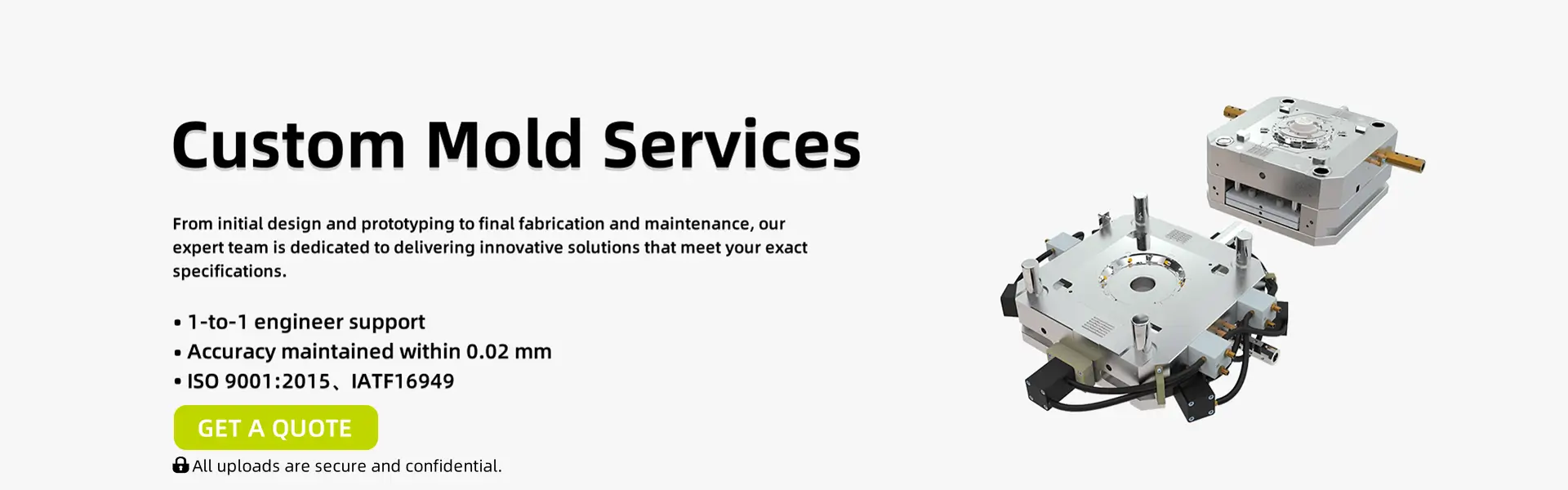
Custom Mold Manufacturing Services
From injection and blow molds to compression and die casting molds and sheet metal dies,
our team of experts can meet all of your molding needs with precision and efficiency.
-

1.Custom Injection Molds
· Single-Cavity Molds: mold one product at a time, suitable for producing small quantities of high-precision parts in a cost-effective prototyping manner.
· Multi-Cavity Molds: multiple cavities in one mold, designed for large-scale production of small parts, can improve efficiency and reduce unit costs.
· Cold Runner Molds: uses a traditional runner system, low-cost, small-batch production, suitable for a variety of thermoplastic materials.
· Hot Runner Molds: Utilizes a heated manifold system to keep the runner at a constant temperature without solidifying, transporting molten plastic, reducing waste and shortening cycle time.
-

2. Custom Blow Molds
· Extrusion Blow Molds: Create hollow plastic parts such as bottles and containers with consistent quality in large-scale production.
· Injection Blow Molds: Combine injection and blow moulding processes to produce precise, uniform hollow parts.
· Stretch Blow Moulds: Combine stretch orientation and blow moulding to significantly improve product strength, transparency, barrier properties and surface gloss. Mostly used in the production of PET bottles, edible oil bottles, high barrier medicine bottles, etc.
-

3. Custom Die Casting Molds
· Cold Chamber Die Casting Molds: suitable for high melting point metals, providing excellent dimensional accuracy and surface finish, suitable for medium and large parts.
· Hot Chamber Die Casting Molds: used for casting low melting point metals, ensuring fast cycle time and high productivity, suitable for small precision parts. Such as (electronic parts, accessories).
-

4. Custom Thermoforming Molds
· Vacuum Forming Molds: Use vacuum pressure to shape plastic sheets, ideal for producing lightweight and cost-effective parts.
· Pressure Forming Molds: Use pressure to create detailed and complex shapes with a high-quality surface finish.
-

5. Custom Compression Molds
· Thermoset Compression Molds: Specializes in molding heat-resistant thermosetting plastics for durable parts.
· Rubber Compression Molds: Ensures high precision and consistency in molded rubber components.
-

6. Custom Transfer Molds
· Thermoset Transfer Molds: Ideal for molding complex thermoset plastic designs and encapsulating components.
· Rubber Transfer Molds: Molding uniform and precise complex rubber parts.
Mold Manufacturing Materials
Our main materials include tool steel, aluminum, and stainless steel,each providing distinct advantages for various applications.

Stainless Steel
Stainless steel can withstand higher temperatures compared to some other mold materials. This property makes it suitable for plastic molding processes that involve elevated temperatures or rapid temperature fluctuations.

Tool Steel
Tool steel is a carbon and alloy steel with high hardness, wear resistance and toughness, making it suitable to withstand the stresses and requirements of die production.

Aluminum
Aluminum may not possess the same hardness and wear resistance as tool steel, aluminum molds offer distinct advantages in terms of cost, lightweight construction, and thermal conductivity.
Mold Design Support Service
We offer comprehensive design support services to ensure your mold designs meet the high standards of precision, functionality, and manufacturability. Our expert team collaborates closely with clients from the initial concept through to the final design, utilizing advanced CAD/CAM software to create detailed, accurate designs tailored to your specific requirements. We provide Design for Manufacturability (DFM) analysis to optimize the performance and efficiency of your molds.
Using advanced technology,we can spot potential problems and correct them before moving the project into production. That reduces costs in the later project phases.

Mold Surface Treatment Services
Each of these surface preparation services plays a critical role in determining the quality, functionality, and longevity of custom molds.
-
Sand blasting
Cleans the mold surface, removes any impurities or previous coatings, and can create a uniform surface texture. It also helps in preparing the mold for subsequent coatings or treatments.
-
Polishing
Polished molds produce parts with a high-quality surface finish, reducing the need for post-processing. It also helps in reducing friction and wear during the molding process, extending the mold's lifespan.
-
Coating
Various coatings, such as PVD (Physical Vapor Deposition), CVD (Chemical Vapor Deposition), or hard chrome plating, can be applied to the mold surface. Coatings improve the mold's resistance to wear, corrosion, and high temperatures. They can also reduce friction, making the molding process more efficient and increasing the mold's service life.
-
Texturing
Texturing applies specific patterns or textures to the mold surface using techniques like chemical etching or laser engraving. Can add aesthetic or functional surface characteristics to the molded parts, such as grip or matte finishes. This can enhance the product's appearance and functionality without additional processing steps.
-
Grinding and Milling
Precision grinding and milling processes refine the mold's surface geometry and dimensions. These processes ensure that the mold's surfaces are perfectly flat and meet tight tolerances.
-
EDM (Electrical Discharge Machining)
EDM uses electrical discharges to remove material and create intricate mold features. Allows for the creation of complex shapes and fine details on the mold surface, which are difficult to achieve with traditional machining methods.
-
Laser Ablation
Uses focused laser beams to remove material and create detailed surface features. This technique provides high precision in creating detailed textures or micro-patterns on the mold surface, enhancing the functionality and appearance of molded parts.
-
Hardening and Heat Treatment
Carburizing, nitriding, or quenching and tempering heat treatment processes are used to harden the mold surface, which can enhance the mold's strength and wear resistance, making it suitable for high-volume production and reducing the frequency of maintenance and repairs.
Dazao's Mold Making Process
We follow a structured 8-part process that transforms your specifications into a perfectly crafted mold.
Create a Drawing
The first step is obtaining or creating the design for the part to be molded, including all necessary dimensions, features, and specifications.
01
DFM
Design for Manufacturability (DFM) optimizes the part or product design to enhance its manufacturability in mold making.
02
Material Selection
The suitable mold material is selected, such as tool steel, aluminum, or other materials based on the specific application.
03
Production Mold
The mold cavities and cores are machined or formed using CNC machining or other techniques based on design specifications.
04
Surface Treatment
The mold surfaces that come into contact with the molten material are treated to improve release and reduce friction.
05
Mold Assembly
All mold components, including cavity, core, inserts, and cooling channels, are assembled into the mold base.
06
Sample Validation
After assembly, the mold undergoes testing and validation to ensure functionality and dimensional accuracy.
07
For mass production
Continuous monitoring of the mold's performance is done during production to ensure consistent part quality.
08
Questions You May Be Thinking About
In the past, you may have experienced the following troubles from your current suppliers.
Delayed Delivery Time
Suppliers will always have various excuses, causing the delivery date to be pushed back several times.
Increased Costs
Hidden costs due to poor quality, rework, maintenance, and delayed delivery can escalate the overall project expenses.
Repeated mold trials
The mold is often repaired and the project schedule is delayed due to design or process problems.
Inadequate Design Considerations
Without proper design support and DFM analysis, the molds may have design flaws that affect production efficiency and part quality.

Why Choose Dazao as Your Mold-Making Company?
Partner with us and let us help you achieve your production goals with confidence and peace of mind.
Stringent Quality Control
We utilize advanced inspection tools, including coordinate measuring machines (CMM) and optical comparators, to conduct thorough quality checks at every stage, ensuring each mold meets exact specifications and performs reliably.
Design Experience and Expertise
Our design team, with over 20 years of combined experience, uses advanced CAD/CAM software and conducts Design for Manufacturability (DFM) analysis to optimize mold designs, identifying and addressing potential issues early to ensure efficient production.
Efficient Project Management
Our dedicated project managers use sophisticated project management tools to monitor progress and ensure on-time delivery, reducing downtime and keeping your production schedule on track.
Strict Confidentiality Agreements
We prioritize the confidentiality of your projects by implementing strict non-disclosure agreements (NDAs) and secure data handling protocols, ensuring your proprietary information and designs are fully protected throughout our collaboration.
Advanced Equipment
Advanced Technology and Equipment
We have invested in cutting-edge CNC machine tools from well-known brands such as Switzerland and Germany, which are capable of producing molds with complex geometries and strict tolerances, ensuring high precision and excellent quality.
Competitive Pricing
Our competitive pricing model includes detailed cost breakdowns and flexible payment options, ensuring you receive the best value without compromising on quality or service.
Our Mold Production Workshop
Seeing is believing, we sincerely invite you to visit our mold factory in China and feel our professional ability!


Frequently Asked Questions About Custom Mold Services
If your question is not listed, please contact us.
What information do you need to provide a quote for a custom mold?
To provide an accurate quote, we need detailed information about your project, including CAD drawings or design files, material specifications, desired production volume, and any special requirements or tolerances.
Do you offer post-production support for custom molds?
Yes, we offer post-production support, including maintenance, repair, and modifications. Our goal is to ensure the longevity and optimal performance of your custom mold.
How do you handle confidentiality and IP protection for custom molds?
We take confidentiality and IP protection very seriously. We are willing to sign non-disclosure agreements (NDAs) and implement measures to protect your intellectual property throughout the project.
How do I start a custom mold project with your company?
To start a custom mold project, you can contact us with your project details, including design files, material requirements, and production specifications. Our team will review your information and provide a detailed quote and project timeline.
