CNC Machined Stainless Steel Racing Brake Caliper Pots
Engineered to stop brake fluid boiling and eliminate high-temperature caliper piston binding on track.
Core Engineering Features:
OD tolerance held to ±0.005mm; roundness controlled to ≤0.003mm.
High-density 304 and 410 stainless steel construction.
75% lower thermal transfer than aluminum to protect fluid.
Staggered multi-piston set weight variation within ≤0.3g.
Vented internal dome options built for endurance racing.
100% roundness profilometer verification on every production run.
5-day rapid prototyping turnarounds without tooling fees.

Product Overview and Precision Machining Capabilities
High-precision cylindrical turning engineered for severe thermal dissipation in professional motorsport calipers.
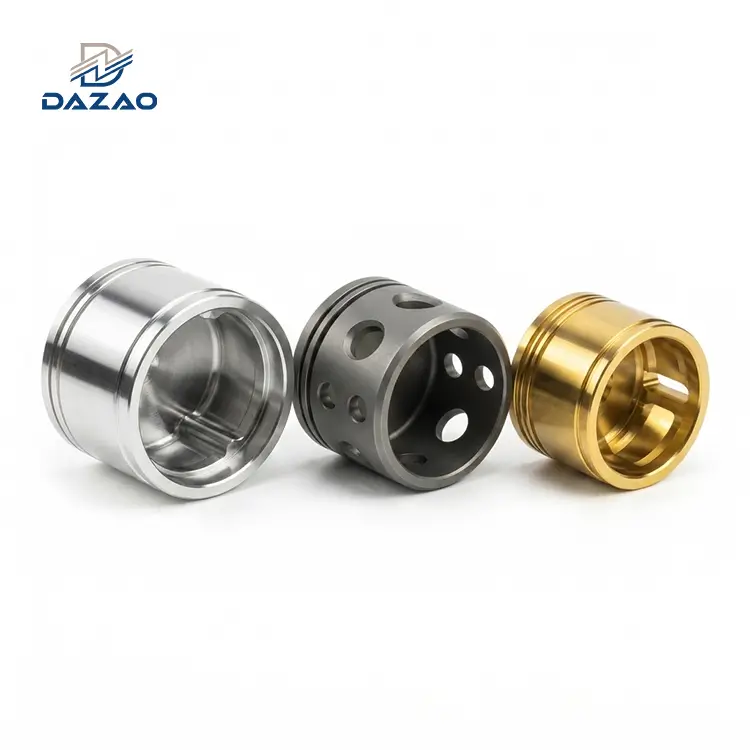
Dazao machines custom CNC stainless steel brake caliper pistons designed for competition calipers subjected to continuous thermal cycling. Utilizing solid AISI 304, AISI 410 martensitic stainless steel, and aerospace-grade titanium alloy bar stock, these components replace factory aluminum and cast iron pots to isolate hydraulic fluid from extreme pad friction heat. We deploy multi-axis 5-axis turning and mill-turn services to execute internal lightening pockets, transverse ventilation channels, and precision seal-groove geometries with total runout tolerances under 0.005mm.
Standard solid configurations provide cost-effective thermal insulation for sprint racing, while internal hollowed geometries provide active airflow cooling for multi-hour endurance events. Because stainless steel exhibits a thermal conductivity rating of only 16.2 W/m·K (compared to 167 W/m·K for 6061-T6 aluminum), our stainless steel brake caliper pots for racing upgrade programs prevent hydraulic fluid boiling, eliminate pedal fade, and stabilize braking torque through severe operating cycles.

Motorsport Engineering Root Cause Analyses and Thermal Upgrades
Field-tested failure corrections that turned real-world track anomalies into validated manufacturing standards.
Mitigating Material Stress Relaxation in Aftermarket Brembo Rebuilds
· Failure Mechanism: During initial production of aftermarket stainless steel pistons for Brembo racing calipers, parts met all dimensional prints immediately after single-pass turning. However, following 7 days of ambient rest, residual machining stresses caused an out-of-round condition exceeding 0.010mm. This dimensional shift produced caliper bore binding and 20% asymmetrical pad taper wear during GT4 track testing.
· Manufacturing Countermeasure: We instituted a multi-stage stress-relief cycle: rough-turning leaving 0.50mm stock, followed by sub-critical annealing at 250°C for 2 hours, and final finishing passes with depth-of-cut below 0.05mm. Every unit is verified on a roundness testing system, ensuring radial runout remains within ≤0.003mm throughout long-term storage and race duty.
Vented Cavity Architecture to Eliminate Thermal Saturation in Endurance Racing
· Failure Mechanism: Solid 410 stainless steel pistons supplied to a 12-hour endurance team lowered fluid temperatures during initial stints. However, continuous heavy braking saturated the solid stainless steel core, allowing trapped heat to migrate into the caliper body and delaying fluid boil by only 20% relative to aluminum.
· Manufacturing Countermeasure: We engineered ventilated stainless steel racing brake caliper pistons featuring a hollowed inner dome, peripheral airflow ports, and face relief channels. Rotational air currents sweep through the internal chamber to evacuate trapped heat. Dyno validation showed a 25% drop in peak fluid temperatures and a 60% delay in thermal brake degradation.
Dynamic Mass Balancing and Concentricity Matching for Staggered Piston Kits
· Failure Mechanism: Custom staggered 6-piston assemblies manufactured to individual component prints caused steering oscillation and pad knockback under high-speed braking. Post-race analysis revealed weight discrepancies exceeding 2.0g between opposing pots and slight concentricity misalignments along the square-seal interface.
· Manufacturing Countermeasure: We established a synchronized manufacturing workflow. Staggered size stainless steel brake caliper pots are machined using continuous toolpaths and matched in weight-indexed pairs within ≤0.3g per caliper set. This ensures uniform seal friction, identical piston retraction, and stable hydraulic force distribution across all caliper bores.

Technical Specifications and Metrology Tolerances
Strict physical and mechanical specifications governed by certified CNC precision turning tolerances.
|
Technical Parameter |
Standard Specification |
High-Performance / Endurance Spec |
Metrology & Verification Method |
|
Material Grades |
AISI 304 Stainless Steel |
AISI 410 Hardened, Ti-6Al-4V |
Spectrometry & Mill Test Report (EN 10204 3.1) |
|
Piston Outer Diameter Range |
20.00 mm to 60.00 mm |
Custom Staggered Diameters |
Mitutoyo Laser Micrometer / CMM |
|
Outer Diameter Tolerance |
±0.005 mm (±0.0002 in) |
±0.003 mm (Specialized Runs) |
Pneumatic Air Bore Gauging |
|
Radial Roundness Limit |
≤0.003 mm (3 μm) |
≤0.002 mm (Superfinished) |
Mitutoyo Roundtest RA-120 Verification |
|
Cylindrical Surface Finish |
Ra 0.4 μm |
Ra 0.2 μm (Diamond Polished) |
Contact Stylus Surface Profilometer |
|
Seal Groove Concentricity |
≤0.005 mm to OD Datum |
≤0.003 mm to OD Datum |
High-Magnification Optical Comparator |
|
Set Weight Matching Variance |
≤0.5 g per kit |
≤0.3 g per kit (Balanced Pairs) |
Calibrated Analytical Balance (0.01g resolution) |
|
Thermal Conductivity |
16.2 W/m·K (AISI 304) |
24.9 W/m·K (AISI 410) |
ASTM E1461 Thermal Diffusivity Testing |
|
Surface Treatment |
ASTM A967 Citric Passivation |
Physical Vapor Deposition (DLC) |
ASTM B117 Neutral Salt Spray Testing (240h+) |
|
Production Dispatch |
Prototypes: 5 Business Days |
Production: 10–15 Business Days |
Full First Article Inspection (FAI) Report |

Engineering Selection Matrix for Materials and Piston Architectures
Clear technical criteria to match specific racing environments with optimal alloy and geometry profiles.
Material Grade Trade-Offs and Performance Capabilities
· AISI 304 Stainless Steel: Offers maximum resistance against chemical and salt corrosion. Optimal for wet circuits, marine applications, and track-day conversions. Yield strength is moderate compared to hardened martensitic grades.
· AISI 410 Martensitic Stainless Steel: Heat-treatable to over 40 HRC, delivering high wear resistance and fatigue strength under high hydraulic line pressures. The standard alloy for high temperature racing brake caliper stainless steel pistons.
· Ti-6Al-4V Grade 5 Titanium: Delivers high thermal isolation while cutting component mass by 40% compared to steel. Recommended for professional sprint and hillclimb classes where minimizing unsprung rotating mass is critical. We provide specialized Grade 5 Titanium machining for these builds.
Piston Internal Geometry and Thermal Dissipation Configurations
· Solid Crown Architecture: Low-cost, high-rigidity profile suitable for short sprint races (under 30 minutes) and street-to-track applications where sustained heat saturation is minimal.
· Vented Internal Cavity: Features a CNC-relieved internal chamber with cross-drilled peripheral holes that circulate moving air behind the piston crown, clearing heat in endurance racing.
· Direct Caliper Retrofit Geometry: Precision reverse-engineered profiles matching factory seal-groove dimensions, including Wilwood caliper stainless steel replacement pots CNC machined for direct drop-in fitment.

Quality Assurance and Multi-Axis Inspection Protocols
Certified quality systems ensuring zero dimensional deviation from raw bar stock to track deployment.
1. Raw Material Spectrometry: Every incoming batch of stainless steel undergoes chemical composition analysis and mechanical tensile testing to confirm alloy specifications.
2. First Article Dimensional Inspection (FAI): Initial production pieces undergo complete coordinate measuring machine (CMM) verification covering bore depths, wall thicknesses, and seal land radii.
3. In-Process Dynamic Tool Wear Monitoring: Automated tool offsets and touch probes maintain tight dimensional control on outer diameters throughout high-volume turning.
4. Dedicated 100% Roundness Metrology: Every finished piston is inspected on a dedicated roundness measuring instrument to confirm cylindrical geometry under 0.003mm.
5. Chemical Passivation and Cleanliness Verification: Components undergo ultrasonic cleaning and chemical surface passivation treatments to remove free iron, followed by microscope checks for burr-free seal grooves.
6. Kit Mass Balancing: Complete multi-piston kits are dynamically weighed and packaged in matched sets to ensure synchronized caliper actuation.
Motorsport Application Sectors and Performance Classes
Mission-critical brake components deployed across rigorous global racing disciplines.

Endurance Circuit Racing (6h to 24h)
Vented stainless steel pistons engineered to prevent fluid boiling and maintain pedal height over multiple stints.

Club and Track-Day Upgrades
Direct replacement pistons designed to resolve piston distortion and fluid degradation issues inherent in factory aluminum units.

High-Humidity and Coastal Racing
Anti corrosive stainless steel brake caliper pots for track cars operating in damp, salt-spray, or wet rally conditions.

Historic Motorsport Restoration
Reverse-engineering and precision turning of obsolete or discontinued brake caliper pistons based on original worn samples.
FAQs

01.Will switching from aluminum to stainless steel brake pistons cause a soft pedal?
02.Why do solid stainless steel pistons sometimes bind in caliper bores after track sessions?
03.When should a race team choose Grade 5 Titanium over stainless steel pistons?
04.Will the higher heat retention of stainless steel pistons damage caliper seals?
05.How does piston weight variance cause pad taper and steering pull?
06.Can solid stainless steel pistons cause brake fluid boiling during multi-hour endurance races?
Submit Your Piston Drawings for Immediate DFM Evaluation
Submit your 2D engineering drawings (PDF with GD&T specifications) and 3D CAD files (STEP, STP, IGS) to receive a detailed manufacturability review, tolerance analysis, and firm quotation within 24 hours.
Contact Us

Hot Tags: stainless steel brake caliper pots,racing caliper pistons,CNC brake pistons,Wilwood replacement pots