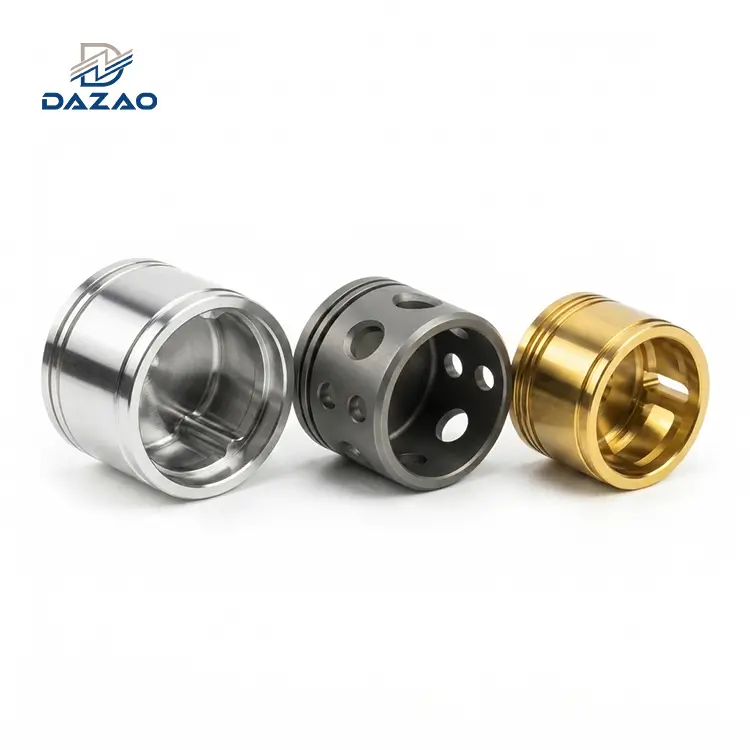

In deepsea offshore environments, the failure of a single manifold component or valve actuator can result in millions of dollars in non-productive time (NPT) and catastrophic environmental risks. For these high-pressure, high-temperature (HPHT) conditions, duplex 2205 machining has become the industry standard. This nitrogen-enhanced stainless steel offers a yield strength nearly double that of austenitic grades and superior resistance to chloride stress corrosion cracking.
However, for most machine shops, oil and gas CNC parts made from corrosion resistant alloys like UNS S31803 or UNS S32205 represent a significant technical hurdle. The very properties that make Duplex 2205 ideal for subsea service (high work-hardening rates and low thermal conductivity) make it difficult for standard CNC milling and turning operations. At Xiamen Dazao Machinery, we analyze the manufacturing process through the lens of metallurgy to ensure that the final part maintains its designed chemical integrity and dimensional stability.

Engineering Comparison: Duplex 2205 vs. Traditional Stainless Steel
|
Property |
Duplex 2205 (UNS S32205) |
316L Stainless Steel |
Impact on Machining |
|
Yield Strength (0.2% Offset) |
450 MPa (65 ksi) |
170 MPa (25 ksi) |
Requires higher cutting forces: increased tool deflection |
|
Thermal Conductivity |
19.0 W/m·K |
16.3 W/m·K |
Heat concentrates at the cutting edge: tool tip degradation |
|
PREN (Pitting Resistance) |
33 to 35 |
24 to 26 |
Higher alloying elements increase abrasiveness |
|
Hardness (Brinell) |
293 HB max |
217 HB max |
Rapid flank wear on carbide inserts |
Technical Pitfalls: Why Standard Machining Fails for 2205 Alloys
Procurement managers often face a recurring issue: parts that pass initial inspection but fail prematurely in the field due to localized pitting or stress cracking. The problem usually starts with a misunderstanding of how corrosion resistant alloys behave under a cutting tool.
Managing Accelerated Tool Degradation
Machining Duplex 2205 is often described as cutting rubber with hard inclusions. The high ductility of the austenite phase combined with the high strength of the ferrite phase leads to severe built-up edge (BUE) and rapid notch wear. Many shops attempt to compensate by lowering cutting speeds, but this often exacerbates work hardening.
Breaking the Cycle of Work Hardening
The moment a dull tool or an incorrect feed rate touches the surface of a 2205 billet, the material undergoes intense localized deformation. This creates a surface layer significantly harder than the core material. If the subsequent machining pass does not penetrate deep enough to get below this hardened layer, the tool will fail within seconds. This cycle of failure is why low-cost providers often struggle with consistency in oil and gas CNC parts.

Dazao Core Methodology: Solving the Three Hidden Failure Points
While most documentation focuses on tool geometry and surface speeds, Dazao Machinery addresses three critical engineering factors that directly influence the long-term reliability of components in deepsea environments.
1. Eliminating Latent Deformation via Multi-Stage Stress Relief
Standard machining practices focus on the dimensions of the part immediately after it leaves the machine. However, Duplex 2205 accumulates massive internal stresses during heavy metal removal. If the machining sequence is not optimized, these stresses will release over time (or worse, during the first thermal cycle in the field).
Dazao utilizes a multi-stage stress-relief protocol. We perform rough machining, followed by a controlled natural aging or low-temperature thermal stabilization, before the final finishing passes. This ensures that a seal groove or a threaded interface remains within a ±0.01mm tolerance for its entire service life, preventing subsea leaks.
2. Protecting Phase Balance in the Micro-Heat Affected Zone (HAZ)
The primary advantage of Duplex 2205 is its 50/50 balance between austenite and ferrite. Conventional high-heat machining can disrupt this equilibrium at the tool-workpiece interface. Excessive heat causes the ferrite grains to grow or promotes the formation of intermetallic phases like Sigma, which are brittle and highly susceptible to corrosion.
Even if the part looks visually perfect (Ra 0.4 finish), the microscopic layer may have lost its corrosion-resistant DNA. Dazao prevents this through High-Pressure Coolant (HPC) systems delivering 70 bar+ directly to the cutting zone, effectively acting as a thermal barrier to protect the material micro-structure.
3. Preventing Stress Corrosion Cracking (SCC) from Clamping Damage
Duplex alloys are sensitive to localized compressive stress. Typical hard-jaw clamping systems used in CNC lathes can leave microscopic indentations on the part surface. In high-pressure oil and gas applications, these indentations act as stress concentrators. Under the influence of hydrogen or chlorides, these sites become the nucleation points for Stress Corrosion Cracking (SCC).
We utilize custom-engineered soft jaws and multi-point pressure equalization systems. By distributing the clamping force across a larger surface area and using sacrificial interface materials, we ensure the integrity of the metallic lattice remains uncompromised.

Buyer Selection Guide: Evaluating CNC Vendors for Subsea Projects
When evaluating a supplier for duplex 2205 machining, price should be the secondary metric. The cost of a subsea failure far outweighs any initial savings. Use these technical benchmarks to vet your manufacturer:
Milling Strategy: Does the shop use standard 316-grade inserts or specialized geometries with PVD coatings designed for high-nitrogen alloys?
Path Geometry: Do they employ trochoidal milling? This technique maintains a constant tool engagement angle, which is mandatory for reducing heat accumulation.
Coolant Infrastructure: Ask about their coolant delivery. Simple flood cooling is insufficient. High-pressure through-spindle cooling is necessary to break the chip and evacuate heat.
Surface Passivation: Ensure the shop follows ASTM A967 for chemical passivation. This process removes free iron embedded during machining, restoring the protective passive layer of the alloy.
Why Xiamen Dazao Machinery for Oil and Gas Components?
Dazao has spent over two decades refining the parameters for corrosion resistant alloys. Our facility is not just a machine shop: it is an engineering partner that understands the chemistry behind the metal.
Certified Quality: ISO9001:2015 and IATF16949:2016 certification ensures full traceability from raw material melt to final inspection reports.
Precision Capability: We maintain tolerances of ±0.005mm on critical mating surfaces for offshore equipment.
Material Expertise: Beyond 2205, we specialize in Super Duplex 2507, Inconel 718, and Monel K500.

FAQs
01.How do you stop Duplex 2205 parts from warping after machining?
02.Why does my Duplex 2205 part show rust spots despite being corrosion resistant?
03.What causes threading tools to break constantly in Duplex 2205?
04.Can the 50/50 phase balance be checked after machining?
05.How do you achieve a Ra 0.4 finish on such a tough alloy?
06.Why is the lead time for Duplex 2205 usually longer than 316 stainless?