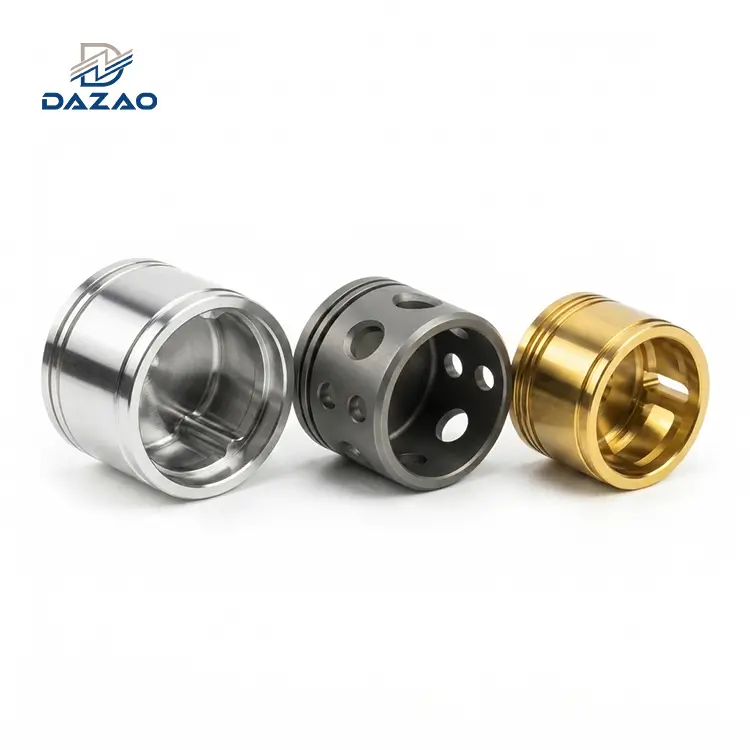

In high-performance imaging systems, mechanical housing precision is as vital as lens quality. Even a sub-micron misalignment during the sensor mount manufacturing process results in optical axis tilt or sensor artifacts. Xiamen Dazao Machinery, an IATF16949 certified facility, provides this technical analysis to assist engineers in balancing mechanical tolerances, surface morphology, and production costs.

Engineering Surface Roughness (Ra) and Practical Application
Surface finish in optical housing machining is not an aesthetic choice but a functional requirement for light scattering control and mechanical seating. We define three tiers of Ra standards based on application needs.
Technical Surface Finish Standards for Optical Components
|
Finish Grade |
Ra Value (μm) |
Mechanical Characteristics |
Typical Optical Use Case |
|
Industrial Grade |
Ra 3.2 |
Traceable tool marks |
Non-critical structural frames |
|
Standard Optical |
Ra 1.6 |
Smooth texture, high seating accuracy |
Camera barrels, standard sensor mounts |
|
High Precision |
Ra 0.4 to 0.8 |
Near-mirror finish, zero friction |
Precision focus rings, vacuum seals |
By applying Ra 0.8 only to critical lens seating steps and relaxing non-contact internal walls to Ra 3.2, procurement teams can reduce CNC machining services costs by approximately 20% without impacting optical performance.

Resolving the Stray Light Problem with Black Anodizing Matte
A major pain point in optical systems is ghosting caused by internal reflections. Standard black anodizing often results in a semi-gloss surface that reflects stray light back into the sensor.
To achieve a true black anodizing matte finish, Dazao utilizes a mechanical pre-treatment using 150# fine glass beads. This process creates a micro-stochastic surface structure that traps photons. When followed by electrochemical oxidation, the resulting surface achieves a diffuse reflectance below 1%. This is critical for LiDAR and infrared sensor housings where signal-to-noise ratios are sensitive to internal light noise.

Overcoming Dimensional Shift in Fine Thread Machining
Optical housings frequently utilize fine-pitch threads (e.g., M12x0.5 or M30x0.75) for axial lens positioning. A common failure in the industry is neglecting the volumetric growth caused by the anodizing layer.
Type II anodizing typically adds 5 to 10 microns of thickness per surface. Without pre-compensation during the CNC turning phase, threads will seize or exhibit excessive torque during assembly. Dazao implements a precision pitch diameter offset during machining to ensure a perfect 6H/6g fit post-plating, maintaining smooth focus adjustment throughout the product life cycle.

Managing Material Stress and Long Term Optical Stability
Aluminum 6061-T6 is the primary choice for optical frames, yet aggressive milling induces residual internal stresses. In high-precision systems, these stresses relax over several months, causing the housing to warp by 10 to 30 microns.
For long-focal-length systems, Dazao incorporates a thermal stabilization cycle between the roughing and finishing passes. This stress-relief process ensures that the optical axis remains stable even when the component is subjected to extreme thermal cycling in aerospace or automotive environments.
Critical Pain Points in Sensor Mount Manufacturing
Heat Dissipation and EMI Shielding
Modern sensors generate significant thermal loads. The housing must act as an efficient heat sink while providing a Faraday cage against electromagnetic interference. Dazao optimizes the contact interface between the sensor and the mount to ensure maximum thermal transfer, utilizing the high conductivity of Al6061.
Preventing Outgassing in Sealed Optics
In sealed camera modules, residual hydrocarbons from inferior cutting fluids can evaporate and deposit a film on the lens. Dazao utilizes a multi-stage ultrasonic cleaning process with medical-grade solvents to ensure zero outgassing, maintaining optical clarity in vacuum-sealed environments.
Why Dazao is the Preferred Partner for Optical Machining?
Dazao operates as a technical partner rather than a simple machine shop. We understand that optical housing machining requires a deep respect for the light path. By integrating IATF16949:2016 quality controls with specialized black anodizing matte techniques, we deliver sensor mounts that are ready for immediate assembly line integration.
Optical Procurement Decision Checklist
· Check if thread tolerances include a 10-micron anodizing allowance.
· Specify 150# sandblasting if the internal path requires zero reflection.
· Inquire about stress-relief aging for thin-walled lens barrels.
· Verify that cleaning protocols prevent outgassing on lens surfaces.

FAQ: Solving Common Issues in Optical Machining
01.Why do my fine threads seize after black anodizing?
02.Can you prevent my aluminum lens barrel from warping over time?
03.How do I get a truly matte black surface that does not reflect light?
04.What is the best way to ensure concentricity in a multi-part lens assembly?
05.How do you handle heat dissipation for high-power sensor mounts?
06.How does Dazao ensure parts are clean enough for a cleanroom assembly?