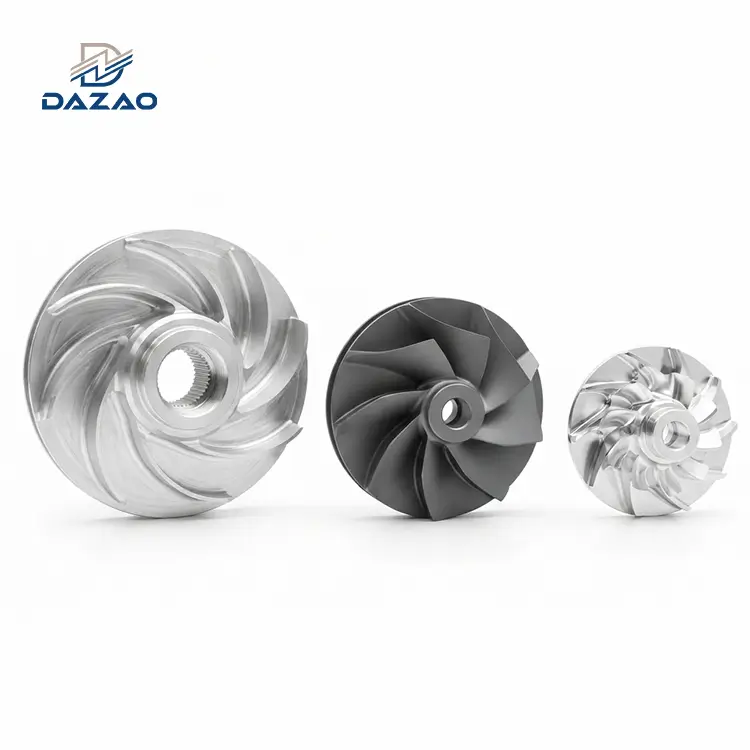
Billet Water Pump Impeller Five Axis CNC Machining Services
Eliminate internal casting voids and cavitation wear with single-setup 5-axis milled monoblock impellers.
Core Engineering Features:
Material versatility: Billet aluminum alloy impeller options in 6061-T6, 7075-T6, and 316 stainless steel.
Strict profile tolerance: Precision 5 axis cnc machining impeller contour accuracy within ±0.05mm.
Rotational stability: G2.5 grade dynamic balancing to prevent high-RPM vibration.
Rapid prototyping: Custom cnc machined impellers delivered in 7 working days.
Material integrity: 100% void-free billet water pump impeller construction.
Performance increase: High flow water pump impeller upgrade increases hydraulic efficiency by 8% to 15%.
Direct OEM partner: Certified oem billet impeller manufacturer with ISO 9001:2015 tracking.

Fluid Dynamics and Surface Finish Evaluation
Transition from high-porosity sand castings to high-density milled profiles with zero tooling overhead.
We manufacture high-performance monoblock 5 axis cnc machining impeller components milled directly from solid billet stock. This method utilizes synchronous toolpaths to cut complex, overlapping blades directly from solid extrusions, supported by our core 5-axis CNC machining capabilities. Unlike cast counterparts that suffer from internal porosity and structural defects, our billet water pump impeller series offers high density, tensile strength, and structural integrity.
By utilizing synchronous 5-axis CNC machining, we cut complex, overlapping blade profiles and high-twist geometries in a single setup. This process eliminates positioning errors, ensures consistent blade thickness, and delivers a surface finish as low as Ra 0.8 without manual hand-filing. This method is optimized for automotive cooling upgrades, industrial centrifugal systems, marine seawater pumps, and closed-loop heat exchangers where fluid dynamics and long-term reliability are necessary.

Dynamic Load and Stress Testing Parameters
Verify exact geometric dimensions, feed configurations, and surface metrics for critical projects.
Every batch undergoes strict dimensional verification. For raw material validation, our CNC aluminum parts manufacturing line guarantees complete compliance with standard alloy certifications:
|
Technical Parameter |
Specification & Tolerances |
|
Primary Materials |
AL6061-T6, AL7075-T6, SUS304, SUS316, H59/H62 Brass |
|
Impeller Diameter Range |
50 mm to 300 mm |
|
Blade Profile Tolerance |
±0.05 mm (Verified via 3D scan CMM) |
|
Inlet/Outlet Angle Tolerance |
±0.05° |
|
Dynamic Balancing Grade |
ISO 1940 G2.5 (100% serialized testing) |
|
Surface Roughness |
As-Machined Ra 0.8 to Ra 1.6 (Bead blast optional) |
|
Concentricity & Runout |
≤0.02 mm |
|
Hard Anodizing Standard |
MIL-A-8625 Type III Hardcoat (≥20 μm thickness) |
|
Acceptable File Formats |
STEP, IGS, XT, DWG, PDF |
|
Production Lead Time |
7 Days (Prototypes), 10–15 Days (Production batches) |
|
Minimum Order Quantity |
1 Unit (Prototype), 50 Units (Production batch price advantage) |

Root Cause Diagnostics and Project Recovery Records
How active field diagnostics and rapid root-cause adjustments saved OEM client projects.
1: Resolving Dynamic Runout and Bearing Failure in Automotive Water Pumps
An automotive aftermarket tuning specialist contracted us to manufacture a high-RPM billet aluminum water pump impeller to replace a stock cast iron unit.
In the initial pilot run, we verified the dimensional tolerances of the mounting bore and outer diameter but bypassed active dynamic balancing. During high-RPM dyno testing (above 6,000 RPM), the pump assembly suffered from audible bearing vibration and shaft seal leakage within 3,000 kilometers of service.
The 5-axis milling toolpaths caused micro-variations in residual stress across the asymmetrical blades, which resulted in a dynamic imbalance of G6.3. Under high angular velocity, this eccentricity loaded the pump bearing asymmetric to its centerline.
We introduced a mandatory dynamic balancing inspection for every production run. We also updated our precision CNC turning services to process critical concentric mounting shafts within ≤0.01 mm of axial runout. Balanced material is selectively removed from non-structural back-face hub pockets. Additionally, we split the 5-axis roughing and finishing paths into distinct operations with a 24-hour stress-relief bake at 150°C between steps.
Dynamic balancing was stabilized below the G2.5 limit. Client field testing showed a 70% decrease in assembly vibration and a 200% increase in bearing and water seal service life.

2: Correcting Blade Contour Deviations to Meet Industrial Hydraulic Efficiency
An industrial pump OEM ordered a custom batch of high-flow centrifugal impellers based on complex mathematical CFD models.
The initial batch failed to meet the rated head and flow criteria during the customer's closed-loop hydraulic performance testing. Actual flow was 12% lower than the design curves.
We programmed the toolpaths directly from the 3D model but did not scan the finished blade contours. Tool deflection during thin-blade milling had caused a minor sweep deviation of up to 0.18 mm near the discharge tips. This changed the discharge angle and reduced hydraulic lift.
We updated our verification process to include 3D laser scanner CMM checks on the first article of every batch. We also updated the toolpaths to use high-feed finishing cutters with variable-helix geometry to minimize tool deflection.
Blade sweep contour deviation was reduced to ≤0.05 mm, and discharge angles matched the drawings within ±0.05°. The revised impellers achieved 98% of the theoretical CFD fluid efficiency.

3: Overcoming Crevice and Pitting Corrosion in Marine Seawater Pumps
A marine engineering client ordered a replacement billet water pump impeller for seawater-cooled diesel engines.
The initial 6061-T6 aluminum impellers, finished with standard decorative anodizing, suffered from severe localized pitting corrosion and boundary degradation after 6 months of seawater exposure.
Standard Type II anodizing produces a thin, porous oxide film (5 μm to 8 μm) that is easily degraded by high-velocity sand particles and salt water, leading to galvanic localized pitting on the aluminum substrate.
We introduced a strict application-specific material selection guide. For seawater environments, we recommend either upgrading to SUS316 stainless steel or applying Type III hard-coat anodization (MIL-A-8625, depth ≥20 μm) sealed in hot nickel acetate.
The hard-anodized 6061-T6 and 316 stainless steel impellers showed no pitting corrosion after 12 months of marine operation.

Billet CNC vs. Traditional Casting Comparison
A structural analysis of density, fatigue limits, and fluid dynamics between manufacturing methods.
|
Parameter |
5-Axis CNC Billet Impeller |
Traditional Cast Impeller |
|
Internal Integrity |
100% dense solid stock, zero voids or porosity |
High risk of internal shrinkage cavities and sand holes |
|
Blade Contour Accuracy |
High precision (≤±0.05 mm blade profile deviation) |
Low consistency due to mold wear and cooling shrinkage |
|
Surface Quality |
Ra 0.8 to Ra 1.6, reducing skin friction losses |
Ra 3.2 to Ra 6.3, requiring manual dressing |
|
Dynamic Balance |
G2.5 grade, low structural wear |
G6.3 to G16, causing high shaft runout |
|
Design Flexibility |
No mold tooling required; modifications made via CAD |
High tooling investment; alterations require new molds |
|
Small-Batch Cost |
Cost-effective for prototypes and runs under 500 units |
High startup costs due to pattern tooling fees |

Material and Structural Selection Matrix
Match specific fluid environments and mechanical stress with the correct alloy and geometry.
1. Material Alloys
· 6061-T6 Aluminum: Best balance of machinability and cost. Ideal for closed-loop freshwater/coolant pumps, radiator setups, and automotive tuning. Restriction: Not suitable for untreated seawater or acidic solutions.
· 7075-T6 Aluminum: High yield strength and fatigue resistance. Ideal for high-pressure centrifugal impellers and high-RPM race pumps. Restriction: Slightly lower corrosion resistance; requires hard anodizing.
· 316 Stainless Steel: Excellent acid, alkali, and chloride resistance. Ideal for marine seawater pumps, chemical dosing, and sanitary food pumps. Restriction: High material cost and longer machining cycle times.
2. Structural Configurations
· Open Impeller: Lacks front or rear shrouds. Well-suited for fluid containing suspended solids or high-viscosity sludge. Restriction: Lower hydraulic efficiency.
· Semi-Open Impeller: Includes a rear shroud only. Good compromise between clogging resistance and mechanical efficiency. Highly common in general-purpose industrial pumps.
· Closed Impeller: Features both front and rear shrouds enclosing the passage. Offers high fluid efficiency and pressure capability. Restriction: Difficult to machine with standard 3-axis setups; requires complex 5-axis undercutting.

Process Control and Material Verification Protocol
Ensuring high rotation stability and dimensional consistency via advanced physical inspection.
Our manufacturing process ensures high precision for every production batch. From raw material arrival to final export shipping, all processes are tracked through our documented quality inspection standards system:
1. Incoming Material Verification: Every batch of raw bar stock undergoes Optical Emission Spectrometry (OES) testing to confirm its chemical composition. We also perform tensile testing to verify mechanical strength.
2. First Article Inspection (FAI): Before launching serial production, the first machined workpiece undergoes a full CMM inspection. We verify the blade contours against the CAD model to ensure errors remain within ±0.05 mm.
3. In-Process Inspection: Machine operators use calibrated dial indicators, custom thread plug gauges, and bore micrometers to check dimensions at defined intervals during the run.
4. Dynamic Balancing Testing: Every impeller is mounted on a balanced mandrel and tested on a dynamic balancing machine. Material is selectively removed from the hub's back-face to achieve an ISO 1940 G2.5 balancing grade.
5. Anodizing and Surface Finish Inspection: Following surface treatments, we measure coating thickness with eddy-current gauges and run cross-hatch adhesion tests.
6. Final Quality Control and Packaging: Finished impellers are cleaned, visually inspected under high-intensity LED lights, and placed into custom-cut polyethylene (PE) foam trays to prevent any shipping damage.

Reliable Hydraulic Solutions Engineered for High-Demand Operating Environments
Proven performance across key heavy industries and high-stress applications.
Our custom machined impellers are designed for high-stress applications across several key industries:

High-RPM Automotive Upgrades
High-flow water pump upgrades for modified engines and race cars that require reliable cooling performance.

Industrial Centrifugal Pumps
Replacement impellers for manufacturing plants, water treatment facilities, and chemical processing plants.

Marine Seawater Cooling
Corrosion-resistant impellers for marine engine cooling pumps and bilge systems.

Industrial Cooling Loops
Heavy-duty impellers for closed-loop cooling towers, chillers, and heat exchangers.
FAQs

01.Is a CNC billet impeller really better than a cast metal impeller?
02.Why do plastic or composite OEM impellers fail, and can billet replace them?
03.What causes impeller cavitation pitting, and how does CNC machining help?
04.Can dynamic imbalance destroy a pump if the shaft runout is perfect?
05.Can I use a billet aluminum impeller in seawater or brackish marine pumps?
06.Why are closed impellers so expensive to machine compared to open designs?
Submit your 2D drawings or 3D CAD models (STEP, IGS, or Parasolid formats) to our engineering department.
Our team will perform a Design for Manufacturability (DFM) review, verify blade clearances, and provide a detailed quotation within 24 hours.
Contact Us

Hot Tags: 5 axis cnc machining impeller,billet aluminum alloy impeller,high flow water pump impeller upgrade,oem billet impeller manufacturer,custom cnc machined impellers,Water Pump Impeller