

What is a High-Precision Aluminum Alloy Drone Frame?
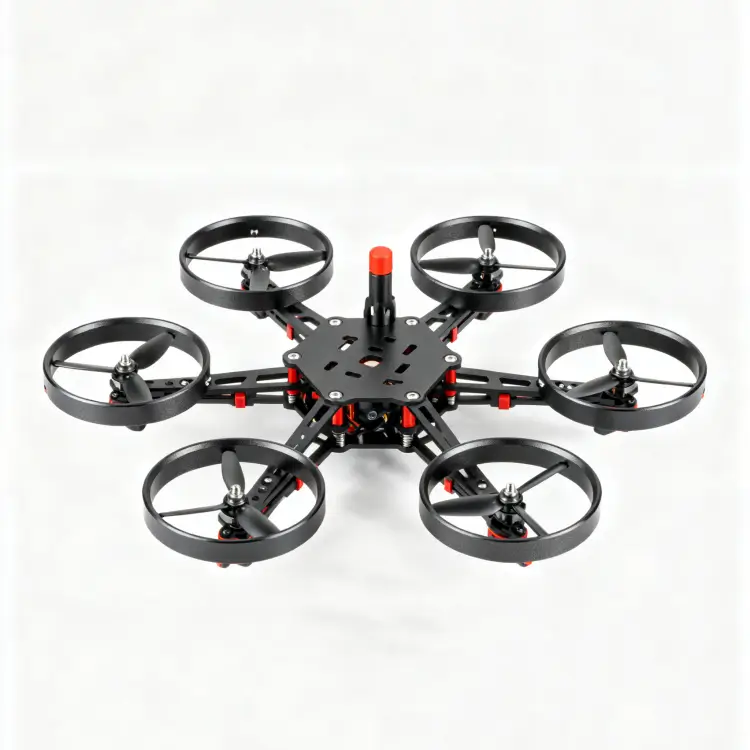
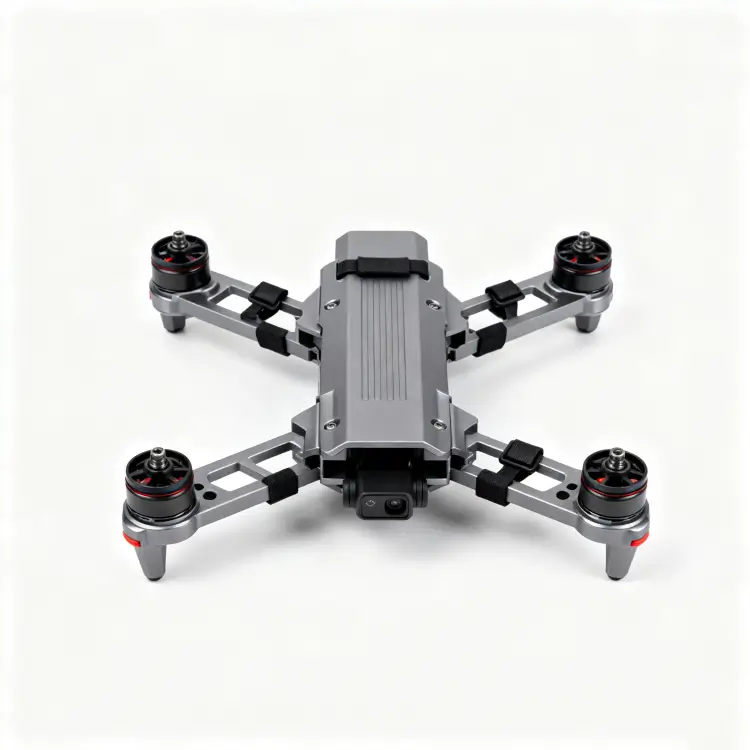
We provide a variety of drone frame customization.

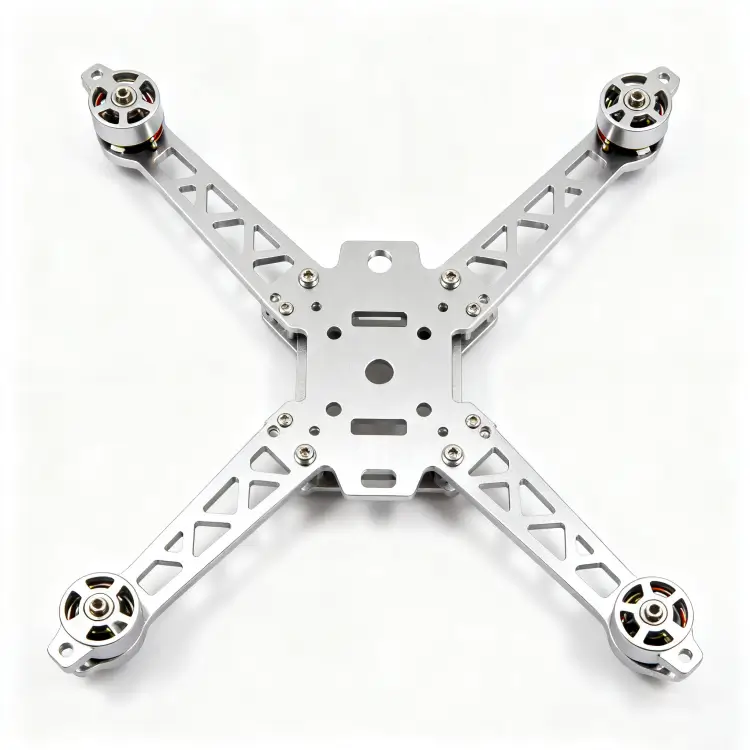
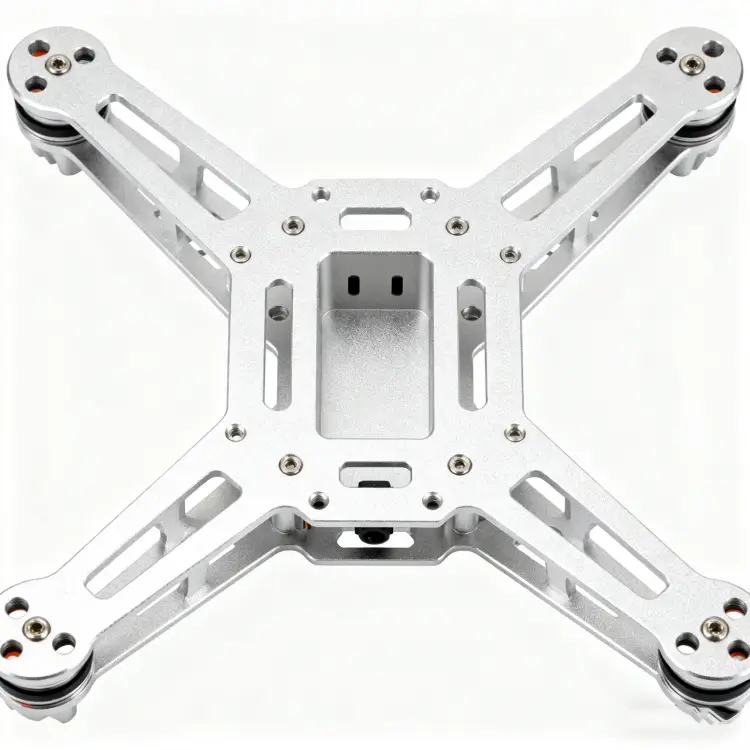
A High-Precision Aluminum Alloy Drone Frame is the main part of a drone. made from strong aluminum alloys like 7075, 6082, and 2024. This frame is created using precise CNC machining, CNC milling, or five-axis machining. It serves as the drone's "skeleton" and support base, responsible for motor mounting, electronic component fixation, and load transmission.
The frame's performance directly impacts flight stability, payload capacity, lifespan, vibration resistance, and safety. A robust aluminum frame is lightweight and precise, providing excellent stiffness and accuracy. It guarantees consistent quality and allows custom to specific needs, providing a competitive edge in the market.
Advantages of High-Precision Aluminum Alloy Frames
Improve efficiency and reduce costs for your drone products
Lightweight Design & High Strength/Rigidity
· Uses high-performance aluminum alloys (e.g., 7075-T6 or 6082-T6), offering high material strength, good rigidity, and excellent fatigue resistance.
· Simulation-optimized to reduce material in non-critical areas, achieving maximum weight reduction without compromising stiffness.
· Rational structural design ensures even load distribution and minimal deformation across the main frame, beams, and connectors.
Light weight without sacrificing strength is a core goal in drone frame design.
High-Precision Machining Ensures Consistency & Interchangeability
· We use CNC five-axis machining and high-precision CNC milling centers. We control errors for shaft holes, tolerances, and mounting hole positions within ±0.02mm.
· Key fitting dimensions (e.g., motor mount holes, stud holes, connection slots) are verified using precision inspection tools and CMMs.
· Excellent batch-to-batch consistency and strong interchangeability during mass production significantly improve assembly efficiency.
Excellent Vibration & Impact Resistance
· Structural design fully considers shock and vibration absorption to reduce vibration transmission (minimizing interference with flight controllers and IMU sensors).
· The aluminum alloy material itself has good fatigue resistance, ensuring a longer lifespan in high-vibration environments.
· You can equip it with damping pads, locking fastener designs, anti-loosening structures, etc., to enhance overall vibration resistance.
Good Corrosion Resistance & Surface Treatment Capability
· Surfaces can be anodized (hard anodizing, black anodizing, color anodizing, etc.) to improve wear and corrosion resistance.
· For extreme environments like islands, salt spray, or marine platforms, anodizing + sealing coating is available.
· You can customize the surface treatment thickness (e.g., 20-25 μm hard anodizing) to balance aesthetics and durability.
Batch Custom & Flexible Delivery Capability
· Accept customer-provided 3D drawings/STEP/IGES/CAD models; we produce according to drawings.
· Mature process from small-batch trial production → prototype validation → bulk supply, with controllable cycles.
· Factory possesses years of experience in NDT, testing equipment, and production, ensuring quality and delivery times.
Cost Competitiveness & Controlled Supply Chain
· Stable material sources and large factory purchase volumes whit keep aluminum material costs low.
· In-house machining and equipment capabilities, with minimal or controlled outsourcing, reduce intermediate costs.
· Discount policies and cooperation systems available for large-volume orders.
Material Selection: Aviation-Grade Aluminum Alloys
Commonly used materials include AL6061-T6, AL7075-T651, AL6082, etc.
These aluminum alloys have distinct advantages:
|
Material Type |
Characteristics |
Suitable Drone Types |
|
AL6061-T6 |
Stable all-round performance, easy to machine |
Multi-rotor drones, Surveying/Mapping frames |
|
AL7075-T651 |
high strength, fatigue resistant |
Industrial heavy-lift drones, Security/Inspection |
|
AL6082 |
Strong corrosion resistance, good weather resistance |
Agricultural spraying drones, Marine operation drones |
All raw materials come from standard aluminum bars, complying with GB/T 3880.2 and ASTM B209 standards.
Product Structure & Composition of High-Precision Aluminum Frames
Here is an introduction to the main parts of a high-precision aluminum alloy drone frame.
It covers the key functions and design points of each part.
1. Main Frame / Central Spar
· The main frame is the backbone carrying all sub-components (motors, arm mounts, center plate, beams). The spar often uses hollow or trapezoidal open-section structures to balance rigidity and weight reduction.
Key design points:
· Optimize spar cross-section shape to reduce bending/twisting deformation.
· Reinforce rigid connection areas (e.g., thickened around studs or rivets).
· Avoid stress concentration in open/grid structure design.
2. Crossbeams / Auxiliary Beams
· Used to connect the main spar to side arms, stabilize the structure, and distribute loads. The overall layout, load, and flight control design determine the number, layout, and cross-section of beams.
Key points:
· Ensure accurate positioning and good hole position consistency for all beams.
· Connection design between beams and main spar must have strong shear resistance.
· For detachable structures, consider quick assembly/disassembly and threaded interface design.
3. Mounts / Motor Mounting Plates
· This is the interface area connecting motors to the frame, experiencing the most concentrated stress. Its design must ensure:
· High rigidity to avoid resonance during motor and propeller operation.
· High hole position accuracy to ensure motor center alignment.
· Can reserved expansion structures (e.g., air ducts, damping structures).
4. Center Plate / Electronics Bay Structure
· The center plate is where you install flight controllers, mainboards, ESCs, and power supplies. The design should think about heat dissipation, wiring channels, and safety.
Design suggestions:
· Electronics bay plate can be multi-layered, with reserved ventilation/heat dissipation slots.
· Design wiring holes/channels rationally to avoid cable damage.
· Ensure reliable connection between plate and beams to prevent loosening from vibration.
5. Reinforcing Ribs / Auxiliary Supports
· In areas with high load or stress, you can add reinforcing ribs or support beams. This helps improve resistance to deformation.
Design principles:
· Place ribs based on Finite Element results.
· Avoid excessive ribbing in low-stress areas to prevent unnecessary weight.
· Ensure smooth transitions when connecting to main/cross beams to avoid stress concentration.
6. Fasteners / Connectors
· Use aviation-grade bolts, nuts (e.g., high-strength nickel alloy, stainless steel, titanium alloy).
· Strict control of thread hole size fit tolerances.
· If you use locking structures (lock nuts, spring washers, etc.), you must design them appropriately.
7. Vibration Damping / Shock Absorption Structures (Optional)
· For drone platforms that need precise measurements and low vibration, you can add damping pads. These pads or elastic connections go between the frame and the electronics or flight control bay.
· While not always essential, these are common upgrades for high-end/commercial/research-grade drones.
Example Technical Parameters
Below are the technical parameters for a sample model (for illustrative purposes;
actual parameters depend on your custom product):
|
Item |
Parameter / Description |
|
Material |
Aluminum Alloy 7075-T6 / 6082-T6 |
|
Main Spar Length |
600 mm (Customizable range 300-1200 mm) |
|
Crossbeam Width |
200 mm |
|
Frame Weight |
Approx. 1.2 kg (Includes electronics bay, excludes motors, screws) |
|
Mounting Hole Accuracy |
±0.02 mm |
|
Surface Treatment |
Hard Anodizing(20 μm ± 2 μm) |
|
Max Payload |
10 kg (Static) |
|
Natural Frequency |
≥ 200 Hz |
|
Operating Temperature |
-20℃ ~ +70℃ |
|
Corrosion Resistance GradeUp |
to C4-C5 level (Salt spray environment) |
|
Batch Consistency Deviation |
≤ 0.05 mm (Hole position / Length) |
|
Customization Scope |
Customizable L/W/H, rib structure, reserved wiring holes, interface layout, etc. |
Applications of High-Precision Aluminum Frames
Here are some typical application scenarios to help you better understand the frame's suitability and provide design inspiration.
-

Agricultural Plant Protection Drones
In crop spraying operations, drones need to carry pesticides, spraying systems, nozzles, tanks, etc., resulting in high overall payload. High-precision aluminum frames provide sufficient stiffness while remaining lightweight, helping extend flight time and improve stability.
-

Surveying / Remote Sensing Drones
These drones often carry LiDAR, high-definition cameras, infrared cameras, GNSS/INS integrated navigation systems. They are sensitive to shake and vibration. A high-quality frame reduces vibration interference, ensuring data accuracy.
-

Logistics / Delivery Drones
For logistics drones, the frame must carry weight and ensure stable flight. It should also provide accurate positioning and resist wind. Frame design must balance strength, stiffness, and modular expandability.
-

Industrial Inspection / Power Line Inspection Drones
Flying in tight spaces, near power lines, and in complex environments needs reliable frames. These frames should resist interference, be compact, and withstand damage.
Customization / OEM Service Capabilities
We offer comprehensive customization and OEM services:
Accept Customer Designs / Models
Accept structural drawings in CAD / STEP / IGES / SolidWorks / Pro/E formats. We produce according to drawings and can provide validation prototypes.
Provide Optimization Suggestions & Structural Improvements
If you give us a preliminary design, we can provide advice to improve it. We will use FEA simulation and structural. This includes suggestions for weight reduction, rib placement, hole design, and load distribution. Our goal is to help you optimize both cost and performance.
Small-Batch Trial Production → Prototype Validation
For new product development or prototype testing, we support small-batch trial production (e.g., 5-20 units). You can physically test structural reliability, compatibility, and assemblability before moving to bulk supply.
Bulk Supply Capacity & Mass Production Support
Our factory has mature capacity management, quality control, supply chain assurance, and delivery processes. For large orders, we support long-term cooperation, staggered orders, and buffer stock to ensure stable supply.
Quality Assurance / Quality Control Process
· Incoming Material Inspection (Material analysis, chemical composition, hardness testing).
· In-Process Control (Key dimension checks, fixture calibration, status monitoring).
· Final Inspection (CMM, dimensional comparison, torque testing, load testing, etc.).
· Environmental Testing (Temperature cycling, salt spray test, vibration test, etc., available per client request).
· After-sales support and quality tracking system.
· We can provide test reports, physical samples, and batch traceability systems.
Purchasing Notes & Cooperation Process
To facilitate smooth cooperation, here is the customization process and key points.
1. Cooperation Process
· Requirement Communication: You provide initial needs, structural drawings, payload requirements, installation layout, etc.
· Proposal / Quotation: We assess structural feasibility and provide technical suggestions, a preliminary design proposal, and a quote.
· Prototype/Sample: After your confirmation, we produce samples (or the first small batch) for your testing.
· Testing & Validation: You conduct performance/compatibility tests; both parties confirm everything is correct.
· Place Order: Sign a formal purchase contract specifying delivery time, payment terms, quality standards, etc.
· Mass Production: We arrange production and conduct quality inspections.
· Shipping & Delivery: Deliver according to the contract, providing packaging, transportation, customs declaration support.
· After-sales Support: Provide guidance, maintenance, spare parts support, quality tracking.
2. Delivery Time & Lead Time
· For standard frames, we typically complete production and delivery within 15-30 days.
· For custom structures (especially large or complex parts), lead time may extend to 30-60 days or longer.
· For large-volume orders, we can reserve production capacity and establish a delivery schedule in advance.
· We support split deliveries / phased shipping to ease your inventory and financial pressure.
3. Packaging & Transportation
· Use shock-absorbing, pressure-resistant packaging (e.g., PE foam, foam, wooden cases, bubble wrap).
· Can meet export packaging standards (e.g., European / American / Sea freight standards).
· Can assist in choosing suitable logistics/courier methods (sea freight, air freight, express, etc.).
· Can provide export documents / inspection certificates / customs support documents.
4. Quality Assurance / After-sales Policy
· We offer a warranty period for delivered frames (e.g., free repair/replacement for structural quality issues within 12 months).
· Provide spare parts and repair/replacement solutions for damaged components.
· If you have subsequent needs for structural modifications, we can discuss modification/upgrade services.
· Provide technical support: assembly guidance, precautions, optimization suggestions.
5. Suggested Cooperation Terms
· Clearly define key dimensional tolerances, assembly principles, and inspection standards in the order.
· We can arrange supply guarantee agreements and priority production access for long-term clients..
· Agree on down payment, installment payments, and final payment milestones.
· We recommend you arrange an acceptance/inspection process (third-party inspection, random sampling tests, etc.).
Frequently Asked Questions (FAQ)
Lorem ipsum dolor sit amet consectetur adipisicing elit.
Q1: Can aluminum alloy drone frames compete effectively with carbon fiber frames?
A1: Carbon fiber is both lightweight and durable, offering excellent resistance to wear and tear. Nonetheless, it is expensive and challenging to manipulate, with issues in consistency and difficulty in repair. Aluminum alloy frames hold advantages in cost, machinability, strength, durability, and recyclability. Especially for bulk purchases, aluminum frames offer better cost control and delivery time assurance.
Q2: Can we control tolerance consistency for bulk orders?
A2: Yes. We have strict processes for production control and inspection. We use CNC equipment, fixtures, CMMs, and quality tracking systems. This helps us ensure that each batch is consistent. We control hole position deviation and dimensional tolerances within ±0.05mm or higher standards.
Q3: Will custom structural design significantly increase costs?
A3: Customization does increase some design and machining complexity costs. However, through pre-assessment, modular design, and shared structural optimization, we keep these costs reasonable. Many custom clients receive favorable discounts and long-term cooperation benefits.
Q4: What is the typical delivery time? Can we guarantee on-time delivery?
A4: Standard models typically take 15-30 days; custom models may take 30-60 days or longer. We verify production capacity before signing contracts, and on-time delivery is our committed responsibility. For major clients, we can reserve capacity and sign scheduling agreements to ensure stable delivery.
Q5: How should we assemble and debug the frame?
A5: We provide assembly manuals, parts lists, and precaution notes. During assembly, pay attention to tightening sequences, thread locking, anti-loosening measures, wiring channels, and damping pads. For new customers, we can also provide technical guidance or video conference support.
Q6: Do you support prototype trials / sample validation?
A6: Yes. For new customers/projects, we recommend producing a prototype (or small trial batch) for testing and validation. Bulk delivery follows after sample approval.
Q7: How after-sales / repair support guaranteed?
A7: We provide complimentary repair or replacement services, covering damage structural quality issues. This warranty is valid for 12 months, and we also offer spare parts support. For issues encountered during use, we offer technical assistance, structural modification suggestions, and component replacement services.

Let Structure Be the Foundation of Flight
We believe that an excellent drone starts with a reliable structure.
Our high-precision aluminum alloy drone frame isn't just about looking light; it's about providing a stable solution.
For customers seeking stability, batch consistency, and cost-effectiveness, we serve as a partner rather than a mere supplier.
If your project requires specific standards for precision, strength, weight, or assembly, please contact our engineering team for a design solution.
Hot Tags: high-precision aluminum alloy drone frame, China high-precision aluminum alloy drone frame manufacturers, suppliers, factory