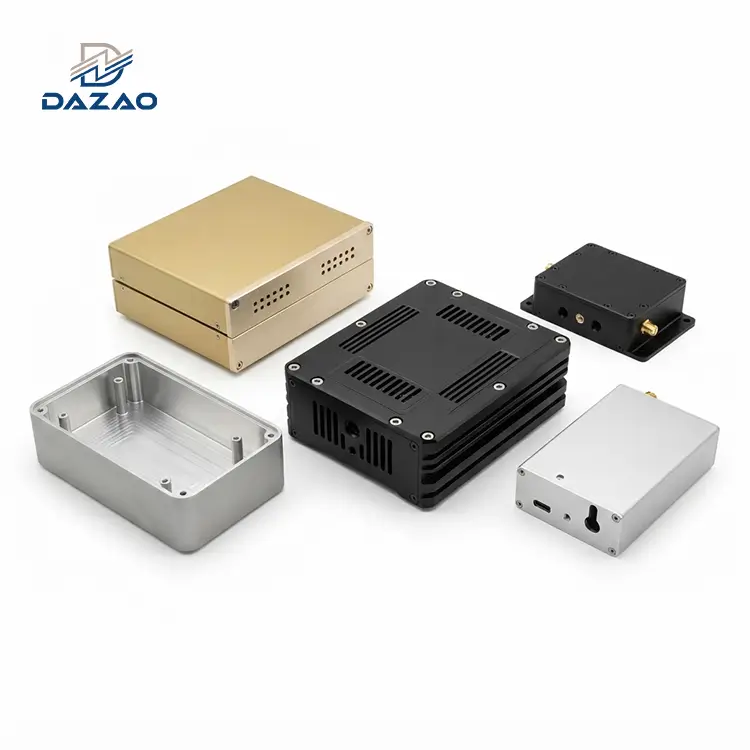
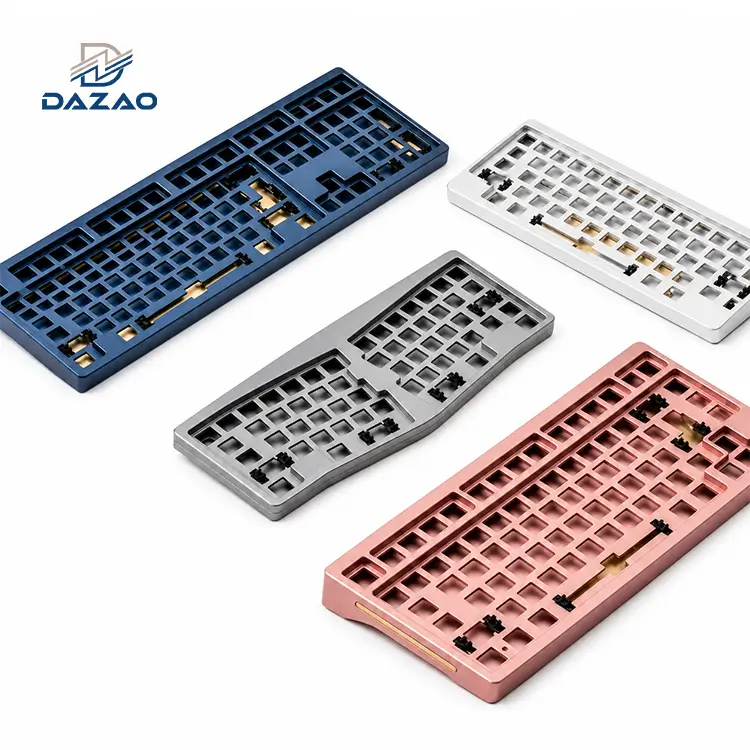
CNC Machining Aluminum Mechanical Keyboard Case Services
High-precision billet aluminum milling for demanding mechanical desktop enclosures.
Core Engineering Features:
Custom CNC aluminum keyboard case options from 1 unit.
Low profile CNC aluminum keyboard case flat to ≤0.05mm.
CNC machined 60 aluminum keyboard case rapid prototyping.
Anodized aluminum cnc keyboard case batch color ΔE≤1.2.
Billet aluminum mechanical keyboard case with zero warp.
Tight assembly tolerance within ±0.02mm for no key sticking.

CNC Keyboard Case Machining Capabilities and Materials
From raw billet preparation to fine-grain sandblasting and controlled chemical anodizing.
We provide high-precision precision CNC machining solutions for aluminum mechanical keyboard cases directly from solid metal blocks. Utilizing 3-axis, 4-axis, and high-speed 5-axis CNC milling centers, we machine AL6061-T6 and AL7075-T6 materials to achieve high dimensional stability. Our production processes support configurations including 60%, 65%, TKL, and full-size layouts, accommodating gasket mount designs and ultra-thin low-profile enclosures. By maintaining a strict ±0.02mm tolerance budget on matching features, we eliminate assembly interference with PCBs, switch plates, and stabilizers.

Mechanical Keyboard Case Technical Specifications and Tolerances
Exact dimensional bounds, material ratings, and structural features for layout engineers.
|
Parameter |
Specification / Capability |
|
Primary Materials |
Aluminum Alloy 6061-T6, 7075-T6; Brass; Copper (for integrated weights) |
|
Machining Equipment |
3-Axis, 4-Axis, and High-Speed 5-Axis CNC Milling Centers, Turn-Mill Lathes |
|
Dimensional Accuracy |
Critical Assembly Tolerances: ±0.02 mm; General Tolerances: ±0.05 mm |
|
Surface Flatness |
≤0.05 mm (strictly controlled for thin-walled low-profile cases) |
|
Layout Standards |
60%, 65%, 75%, TKL (87), Full-Size (104/108), custom split/ergonomic layouts |
|
Mounting Styles |
Gasket Mount, Tray Mount, Top Mount, Integrated Plate, Sandwich Mount |
|
Surface Finishes |
Sandblasting (120# to 220# glass beads), Type II/III Anodizing, Laser Engraving |
|
Anodizing Color Control |
Batch-to-batch color variance limited to ΔE ≤ 1.2 |
|
Acceptable File Formats |
STEP, IGS, DXF, DWG, PDF |
|
Minimum Order (MOQ) |
1 piece for engineering prototypes up to 5,000+ pieces for mass production |

Keyboard Enclosure Engineering Case Studies and Corrective Actions
Practical root-cause adjustments that solved real-world assembly and finishing challenges.
Case Study 1: Solving Plate Alignment and Key Binding in Sixty Percent Keyboard Cases
An offshore client experienced a 30% failure rate during final assembly of their crowd-funded 60% layout case. Although the case matched nominal drawing dimensions, the tolerance stack-up with third-party PCBs and plates caused alignment offsets on keycap clearances, causing switches to bind or sit unevenly.
Machining individual mounting bosses without calculating the maximum material condition (MMC) of mating plates led to tolerance accumulation. Slight variances in the positioning pins forced the PCB to flex when tightened.
We developed a multi-part tolerance budget matrix. Now, we analyze the client's mating PCB and plate drawings to offset tolerances in our CAM programming. Additionally, our QA department conducts full-scale physical assembly checks using functional PCBs, switches, and stabilizers before shipping production batches, raising final assembly pass rates to 99%.
Case Study 2: Managing Color Consistency and Contact Marks in Space Gray Anodizing
A brand-owner rejected a batch of space gray mechanical keyboard cases due to severe visual color shifts between manufacturing runs and visible racking marks on the external chamfer lines.
Processing parts in separate chemical tanks with varying current density and temperature caused anodizing thickness variations. Unsuitable racking locations forced contact pins against visible cosmetic edges.
We standardized a cosmetic-grade anodizing control protocol. All racking positions are moved to internal screw holes, leaving cosmetic surfaces unmarked. We process volume runs in a single chemical bath under stabilized current and temperature to limit color variance to ΔE≤1.2. Sandblasting parameters (nozzle distance, media grit, and air pressure) are locked in to ensure a uniform matte finish.
Case Study 3: Controlling Material Deformation in Thin Walled Low Profile Enclosures
A client experienced warping on a low-profile case with a 1.5mm bottom wall thickness. After machining, internal material stresses caused the keyboard base to bow upwards by 0.4mm, causing the keyboard to rock on flat surfaces.
Milling large internal pocket volumes from a solid billet block released significant residual stress within the cold-rolled AL6061-T6 bar stock. Standard single-pass machining warped the thin bottom section.
We optimized our toolpath to utilize alternating multi-pass shallow roughing cuts (maximum 0.5mm depth). We inserted a low-temperature stress-relief thermal annealing step between roughing and final precision finishing passes. Traditional mechanical clamping plates were replaced with vacuum chucks to eliminate clamping stress. Overall flatness is now consistently held to ≤0.05mm.

Metrology Inspection Standards and Quality Control Protocols
Verified through rigorous coordinate metrology, stress-relief steps, and colorimetry audits.
Our facility operates under an ISO 9001 certified quality management system to enforce dimensional and aesthetic uniformity:
· Incoming Material Verification: Every raw aluminum billet batch undergoes Optical Emission Spectrometry (OES) testing to verify alloy composition, accompanied by Mill Test Reports (MTR).
· First Article Inspection (FAI): We conduct a complete FAI dimensional report on the initial part of every setup using Coordinate Measuring Machines (CMM).
· In-Process Monitoring: CNC operators inspect critical mounting dimensions every 10 parts, monitoring tool wear to prevent dimensional drift.
· Flatness and Alignment Testing: We verify case flatness on precision-ground granite surface plates to guarantee rocking-free operation.
Cosmetic Inspection: Post-anodizing parts are inspected under 1000-lux color-matching lamps to screen for anodizing runs, scratches, or color variance.
· Export-Grade Protective Packaging: Each case is packaged in individual, custom-cut polyethylene (PE) foam nests and double-walled cartons to prevent transit damage.
Industrial Application Scenarios and Structural Layout Options
Engineered enclosures for specialized workspaces, medical terminals, and brand runs.

Custom Enthusiast & Group-Buy Brands
Precision-machined custom billet shells supporting distinct brass/copper weight configurations and unique gasket mounting designs.

Commercial Office Workspaces
Low-profile slim cases designed for ergonomic, low-impact desktop typing setups.

Industrial Control Terminals
Heavy-duty, sealed, non-porous billet cases designed for rugged operator consoles and dust-heavy industrial environments.

High-Performance Gaming Peripherals
Heavy base cases featuring integrated metallic weights to increase desktop friction and prevent slipping during intense inputs.
Get A Quote for CNC Machining Aluminum Mechanical Keyboard Case
Frequently Asked Questions About Aluminum Keyboard Case Machining

01.Can you manufacture a custom cnc aluminum keyboard case?
02.Do you produce a cnc machined 60 aluminum keyboard case?
03.Do you offer surface finishing for an anodized aluminum cnc keyboard case?
04.Can I order a cnc aluminum keyboard case prototype before bulk production?
05.How do you guarantee a high quality cnc machined keyboard case?
06.What are the benefits of a cnc billet aluminum mechanical keyboard case?
Obtain structural validation and rapid production pricing from our engineering team.
Maximize Your Assembly Yield with Precision Machining
Avoid assembly failures, keycap rubbing, and color inconsistencies. Upload your 2D/3D CAD files (STEP, IGS, DXF) today for a rapid DFM assessment and an engineering quotation within 24 hours.
Contact Us

Hot Tags: cnc machined aluminum mechanical keyboard case, anodized aluminum cnc keyboard case, cnc billet aluminum mechanical keyboard case