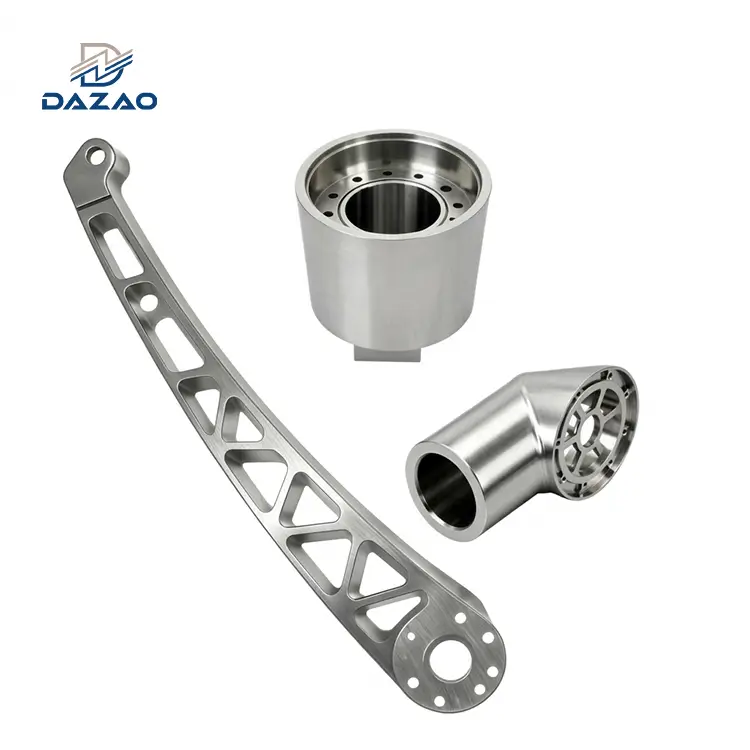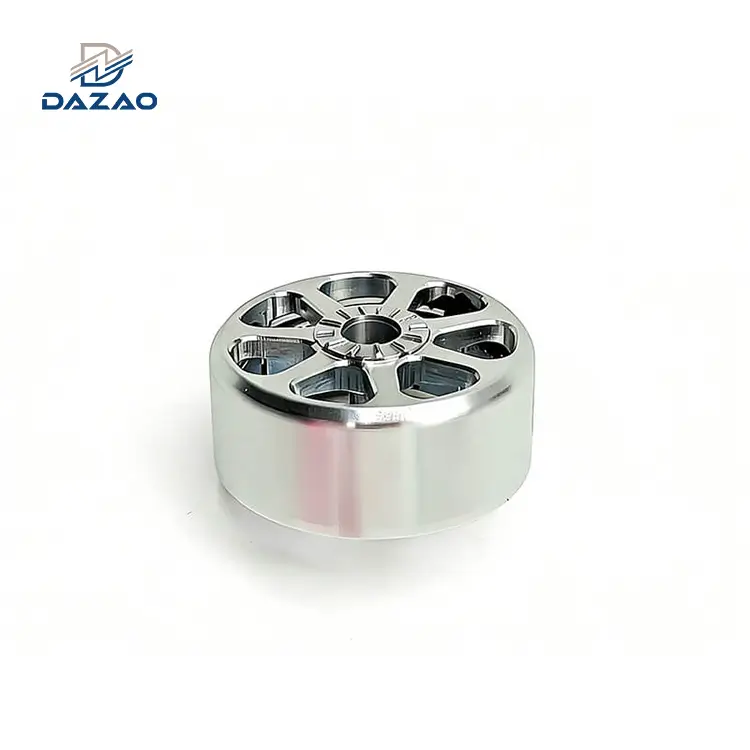

The rapid escalation of heat flux in EV power modules and high frequency telecommunications has rendered traditional cooling components obsolete. Standard thermal solutions often fail to address the thermal bottlenecks associated with high power density. CNC machined heat sinks represent the elite tier of thermal management parts, offering the geometric precision required to maximize surface area within restricted spatial envelopes. At Xiamen Dazao Machinery, we leverage ISO9001 and IATF16949 certified processes to manufacture complex cooling structures that ensure operational stability for mission critical electronics.
Engineering Realities: Technical Field Observations on Thermal Component Failures
Detailed feedback from mechanical engineers in the aerospace and robotics sectors reveals a consistent set of failures in outsourced cooling components. Project managers often report that theoretical thermal models do not align with hardware performance due to three specific manufacturing flaws.
1.Contact Interface Failure: Engineers frequently encounter base plate convexity in mass produced parts. Even a 0.03mm deviation in flatness creates a high resistance air pocket, causing semiconductor junction temperatures to spike beyond safe limits.
2.Fin Integrity Issues: High aspect ratio fins produced by low end shops often exhibit visible vibration marks. These structural inconsistencies disrupt air flow and reduce the effective heat transfer coefficient.
3.Prototyping Lag: A major pain point for R&D teams is the inability to source custom copper heat sink design prototypes without a 6 week lead time, stalling critical testing phases.
Managing Residual Stress for Long Term Base Plate Planarity
A significant oversight in the production of thermal management parts is the ignore of residual stress induced by aggressive milling. When machining large Al6061 or C11000 plates, the removal of surface material redistributes internal stresses.
Most manufacturers only inspect flatness immediately after machining. However, once the heat sink undergoes repeated thermal cycling in the field, it will warp. Dazao addresses this by integrating multiple stress relief annealing cycles. This ensures the heat sink base maintains a flatness of ±0.01mm throughout its entire lifecycle, maintaining a perfect seal with the thermal interface material.
Optimizing Fin Aspect Ratios and Tool Deflection Control
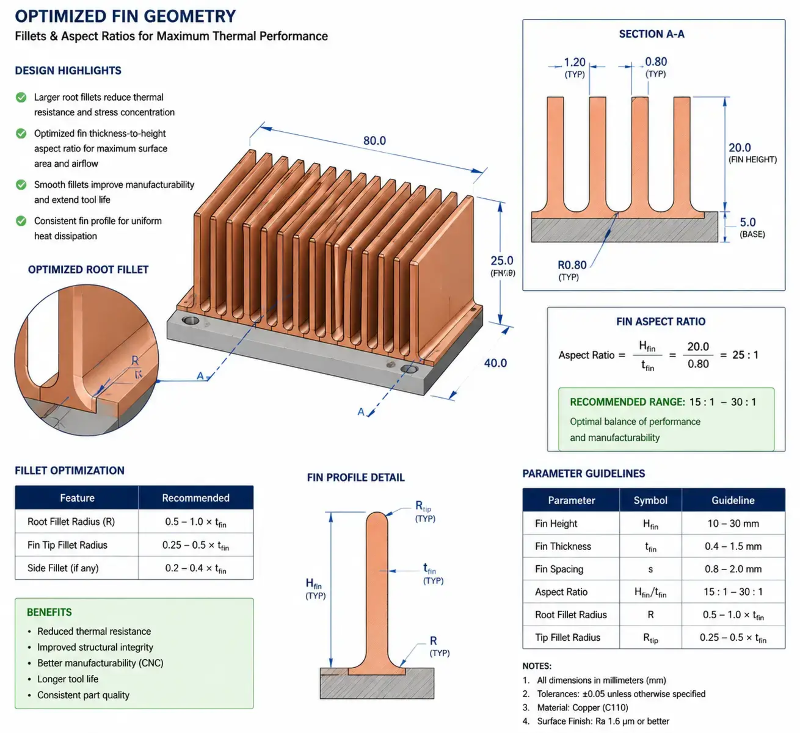
The pursuit of maximum surface area often leads to thin fin designs that are impossible to machine reliably. When the height to thickness ratio exceeds 15:1, standard end mills produce chatter.
Dazao engineers optimize CNC machined heat sinks by implementing a variable fillet design at the fin root. This structural reinforcement increases the stiffness of the fin, allowing for thinner walls without the risk of tool deflection. This precision machining approach ensures that each fin remains perfectly parallel, minimizing static pressure drop in forced air cooling systems.
Mitigating Micro Burrs to Eliminate Air Boundary Layer Disturbance
Theoretical thermal simulations assume perfectly smooth fin surfaces. In reality, micro burrs at the base of CNC milled fins create microscopic turbulence that disrupts the laminar boundary layer. This turbulence increases fan power consumption and creates localized hot spots.
Dazao utilizes advanced abrasive flow machining and chemical deburring to ensure every internal channel is smooth. By reducing the surface roughness to Ra 0.8 or better, we enhance the air velocity through the fins, which directly correlates to a lower thermal resistance (Rth).
Strategic Copper Heat Sink Design: Material and Efficiency Comparison
Selecting the correct alloy is the first step in optimizing copper heat sink design.
While pure copper provides maximum conductivity, its machining cost is higher due to tool wear and slower feed rates.
|
Material |
Thermal Conductivity (W/m·K) |
Hardness (HB) |
Recommended Application |
|
C10100 (OFC) |
391 |
40-50 |
Cryogenic and vacuum systems |
|
C11000 (ETP) |
385 |
45-55 |
Standard high power IGBT cooling |
|
C14500 (Tellurium) |
350 |
60-80 |
Complex 5-axis machined geometries |
|
Al6061-T6 |
167 |
95 |
Weight sensitive aerospace parts |
For high complexity parts, C14500 is often the superior choice because its improved machinability allows for tighter fin spacing and better surface finish, which often compensates for the slightly lower bulk conductivity.

Procurement Decision Matrix: Identifying a Competent Thermal Partner
When evaluating suppliers for CNC machined heat sinks, technical buyers must move beyond price per unit. The following criteria are vital for high reliability applications:
In-House Stress Relief: Can the supplier prove they perform annealing to prevent warping?
Microscopy Inspection: Does the quality lab check for micro burrs in the fin roots?
DFM Expertise: Will the supplier suggest modifications to the fin fillet to improve yield and performance?
At Dazao, we provide a full DFM analysis for every quote, ensuring that your thermal management parts are optimized for both performance and manufacturability.
Summary: Precision as the Core of Thermal Excellence
The efficiency of a cooling system is only as good as its weakest mechanical interface. By focusing on residual stress management, fin root optimization, and boundary layer control, Xiamen Dazao Machinery delivers heat sinks that exceed standard performance metrics.

FAQs
01.Why does my custom copper heat sink warp after several thermal cycles?
02.Can CNC machining achieve thinner fins than cold forging?
03.How do micro burrs at the fin root impact my cooling system?
04.What is the benefit of Tellurium Copper over ETP Copper for heat sinks?
05.How does Xiamen Dazao verify the flatness of large thermal cold plates?
06.Is it possible to prototype a custom heat sink in under 10 days?