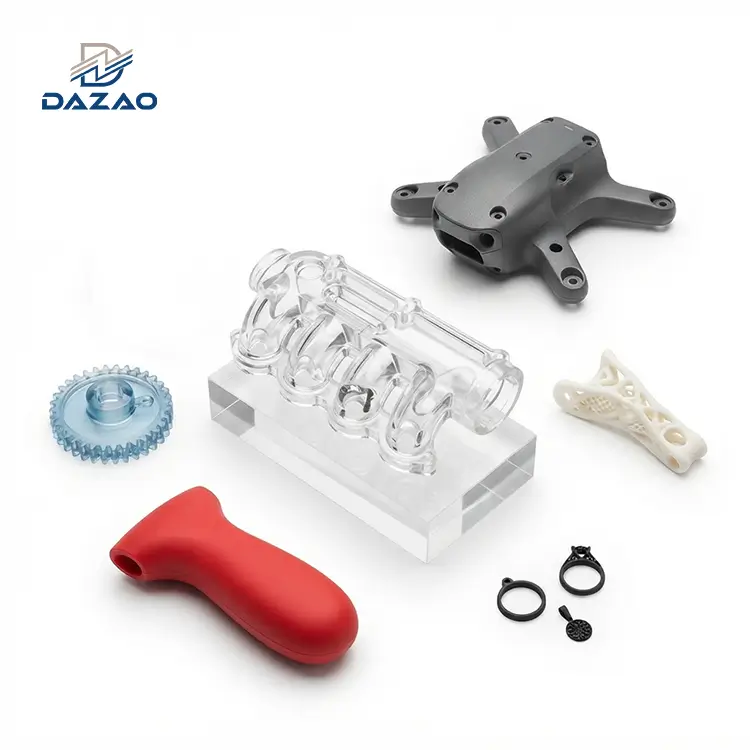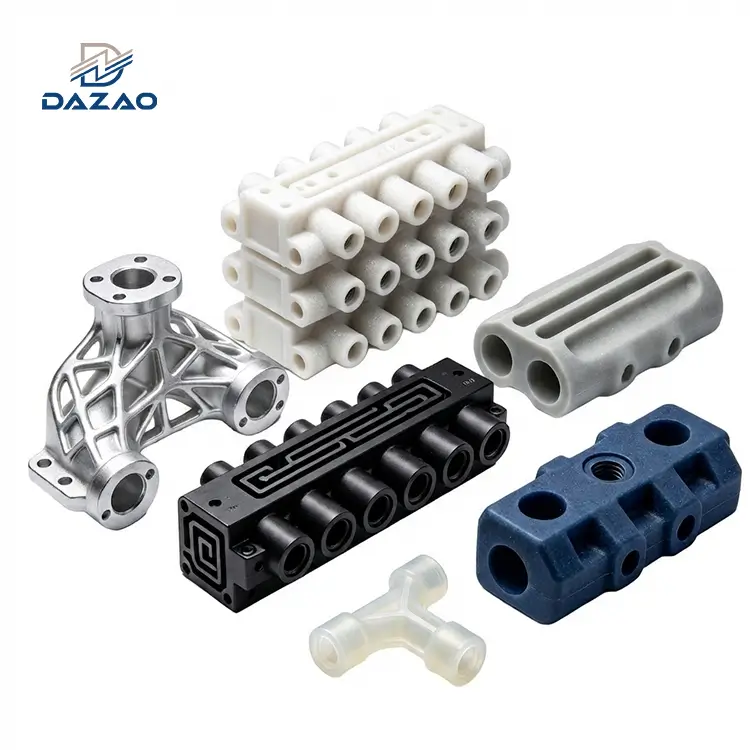

In the high-stakes sectors of medical diagnostics, automotive lighting, and aerospace instrumentation, the choice between Acrylic (PMMA) and Polycarbonate (PC) is rarely about cost-it is about the physics of light and the chemistry of post-processing. At Xiamen Dazao Machinery, an IATF16949-certified facility, we see hundreds of clear plastic machining projects fail in the design phase because the buyer treats transparency as a singular material property.
The reality of clear plastic machining involves balancing the refractive index against impact toughness, and tool-path strategy against secondary chemical finishes. This guide provides a deep-dive DFM analysis to assist CPOs and engineers in making data-driven procurement decisions.
Optical Excellence: Acrylic (PMMA) Machining Protocols
Polymethyl Methacrylate (PMMA) remains the primary choice for light pipes and optical manifolds due to its 92% light transmission rate. However, its high surface hardness makes it notoriously brittle.
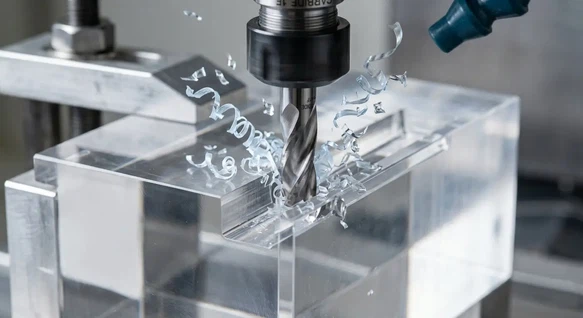
1. Avoiding Brittle Fracture in CNC Milling
PMMA behaves like glass during high-speed cutting. Standard tool geometries often cause micro-chipping at the exit of a cut. Dazao utilizes single-flute O-flute end mills with polished rakes to minimize friction and ensure that the heat is carried away by the chip, not the part. Achieving a surface finish of Ra 0.4 before polishing is the baseline for high-transparency results.
2. The Limits of Mechanical Polishing
Unlike PC, acrylic responds exceptionally well to diamond polishing and manual buffing. Because it does not soften at low temperatures, it can be polished to a mirror finish without the smearing or gumming that plagues softer polymers.
Structural Integrity: Polycarbonate (PC) and Vapor Polishing Tech
Polycarbonate is chosen for its impact resistance-200 times stronger than glass-making it the standard for protective covers and structural clear housings. But this toughness comes with a polishing tax.
1. The Heat-Induced Melting Problem
PC has a lower heat deflection temperature than PMMA. During clear plastic machining, if the spindle speed and feed rate are not perfectly synchronized, the material will gum up on the tool, resulting in a permanent milky haze. Dazao engineers prioritize high-pressure air cooling over liquid coolants to maintain material purity during the cut.
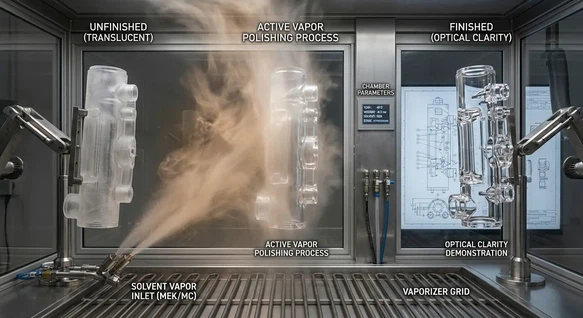
2. Advanced Vapor Polishing PC Processes
Since PC is difficult to buff manually, we utilize vapor polishing PC techniques. By exposing the machined part to a controlled solvent vapor (typically methylene chloride), the outer skin of the PC melts and reflows into a perfectly smooth surface. This is critical for achieving clarity in internal cavities where mechanical tools cannot reach.
Material Performance Benchmarking (Metric)
|
Engineering Property |
Acrylic (PMMA) |
Polycarbonate (PC) |
|
Light Transmission |
92% |
89% |
|
Refractive Index |
1.49 |
1.58 |
|
Impact Strength (Izod) |
16 - 21 J/m |
600 - 900 J/m |
|
Glass Transition (Tg) |
105°C |
147°C |
|
Machinability Rating |
High (Brittle) |
Moderate (Gummy) |
|
Primary Finishing |
Diamond/Buffing |
Vapor Polishing |
Community Analysis: Solving the Crazing and Stress Failures
The manufacturing community frequently discusses the sudden failure of clear parts weeks after delivery. At Dazao, we have identified and solved these common pain points through engineering-led protocols.
The Chemical Sensitivity Problem: A recurring complaint is that PC parts crack immediately after being wiped with Isopropyl Alcohol (IPA). This is due to residual surface stress from the machining process.
The Yellowing Disappointment: Users often report that vapor-polished parts turn yellow. This is a result of solvent contamination.
The Thread Failure Issue: Engineers often struggle with cracked threads in clear plastics. Our DFM feedback always suggests avoiding tapered pipe threads in PMMA and instead using straight threads with O-rings to distribute stress.
The Dazao Standard: 3 Non-Negotiable Steps for Clear Part Stability
Most machine shops treat clear plastic machining like aluminum. Dazao applies a specialized post-machining workflow that ensures long-term part survival.
1. Proprietary Degassing Cycle
Vapor polishing leaves residual solvent trapped in the polymer matrix. If shipped immediately, this solvent causes delayed crazing. Dazao implements a 24-hour degassing cycle in a vacuum chamber to ensure the part is chemically stable before packaging.
2. Tolerance Compensation for Surface Reflow
Vapor polishing is a subtractive/additive process-it rounds off sharp edges and can reduce wall thickness by up to 0.03mm. We adjust our CAD models at the CAM stage to compensate for this material shift, ensuring that your ±0.05mm tolerances are maintained after the polishing is complete.
3. Stress-Relief Annealing
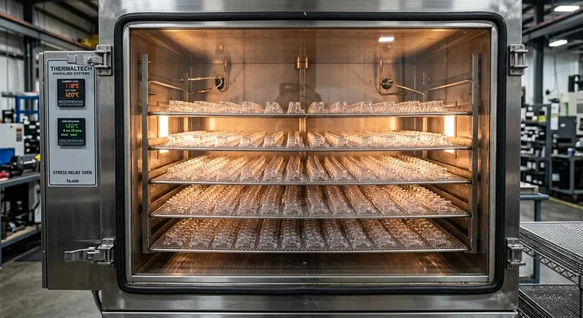
Machining introduces localized heat and mechanical stress. Dazao subjects all acrylic CNC parts and PC housings to a multi-stage annealing oven cycle. This process realigns the polymer chains, significantly reducing the risk of spontaneous cracking when the part is exposed to cleaning agents or thermal cycling in the field.
Decision Matrix: Choosing the Right Transparent Polymer
Select PMMA (Acrylic) if:
· You need the highest possible light transmission (Light pipes, Lenses).
· The part is for decorative or display use where scratch resistance is key.
· The environment is outdoors with high UV exposure.
Select Polycarbonate (PC) if:
· The part must survive a drop test or high-impact environment.
· Operating temperatures will exceed 90°C.
· The geometry has internal channels that require vapor polishing for clarity.
Conclusion: Accuracy Beyond Transparency
Achieving clarity in clear plastic machining is an engineering discipline, not just a finishing step. By understanding the interaction between material stress and post-processing chemistry, Dazao delivers parts that maintain their integrity long after they leave the factory floor.

FAQs
01.Why did my polycarbonate part crack after I cleaned it with alcohol?
02.Can vapor polishing be used on acrylic parts?
03.How do you maintain tight tolerances after vapor polishing?
04.Why is my acrylic part chipping at the edges?
05.Is it possible to get clear threads in a polycarbonate part?
06.Does PMMA yellow over time like Polycarbonate?