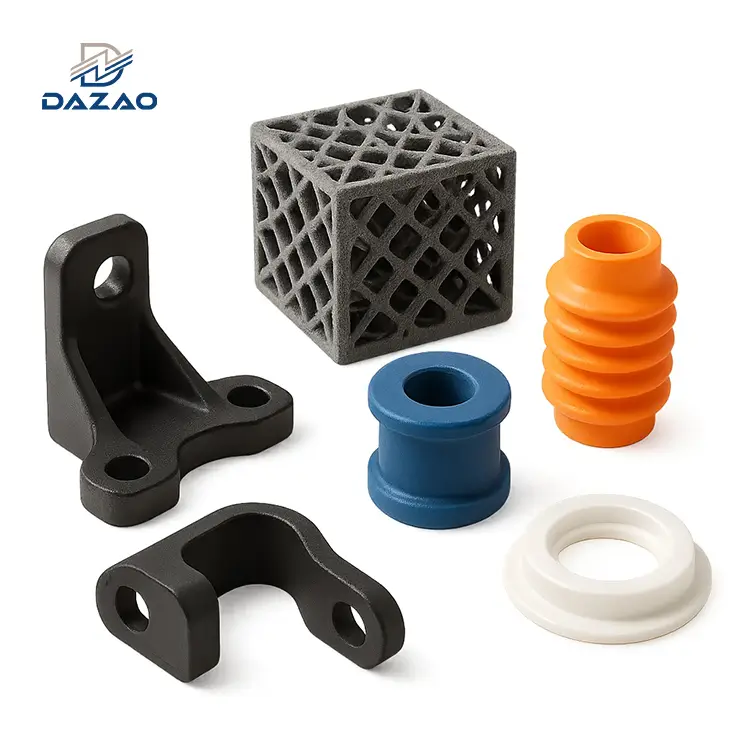
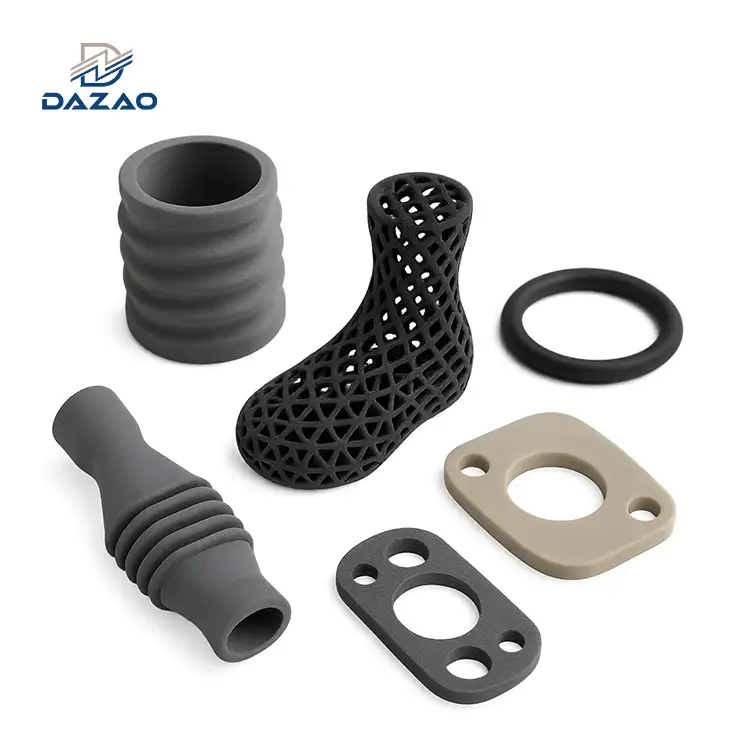
Industrial MJF TPU 3D Printing Services for Elastomer Parts
Eliminate Tooling Costs and Accelerate Production with Low-Volume High-Performance Elastomers.
Core Engineering Features:
Shore 75A-98A industrial MJF TPU printing services on-demand.
3D printed TPU lattice structures for shock absorption.
Custom 3D printed TPU seals and gaskets with <0.3% leak rate.
Vapor smoothed MJF TPU 3D printing for sealed finishes.
Abrasion resistant 3D printed flexible components.
Low volume production for 3D printed TPU parts.
High elasticity MJF parts for automotive industry.
Rapid 3-day lead time for functional DFM prototypes.

Industrial MJF TPU 3D Printing Capabilities and Material Elastomers
Engineered for High Elasticity and Isotropic Strength Across Shore 75A to 98A.
We provide industrial-grade thermoplastic polyurethane (TPU) powder printing using HP Multi Jet Fusion systems. This production method yields high-density flexible components featuring isotropic mechanical properties, eliminating the layer adhesion weaknesses commonly found in standard FDM parts. Our on-demand process achieves a raw density of over 98%, producing functional parts that match the physical qualities of injection-molded rubber without the high initial cost of steel molds.
Our facility supports a complete range of Shore hardnesses from 75A to 98A. For applications requiring low surface friction and enhanced sealed barriers, we integrate specialized vapor smoothed MJF TPU 3D printing post-processing. These flexible components are designed for essential applications in automated pneumatics, collaborative robotics, automotive wire routing, and medical orthotics.

Elastomer Manufacturing Case Studies and Root Cause Engineering Solutions
How We Solved Real-World Performance Failures to Build Bulletproof Reliability.
Case Study 1: Micro-porosity Failure of Pneumatic Piston Seals at 0.6 MPa
· Client Profile: United States industrial pneumatic actuator manufacturer.
· Application: Static seals for pneumatic cylinder end-caps under a continuous 0.6 MPa working pressure.
· Initial Failure: The client ordered 3,000 TPU seals printed using standard default machine parameters. During final assembly inspection, 22% of the pneumatic cylinders failed pressure retention tests. Pressurized air leaked through microscopic voids within the printed layers, causing system pressure loss. Dazao covered the air-freight shipping, assembly labor, and client downtime costs, resulting in a loss of $15,300.
· Engineering Root-Cause: Multi Jet Fusion TPU parts naturally exhibit micro-porosity if the sintering energy density is not calibrated for the component's cross-sectional geometry. Standard post-processing cannot seal internal interconnected voids under active gas pressure.
· Corrective Actions:
1. We optimized the machine's infrared fusing energy profile, raising the thermal density to increase the raw printed density to over 98%.
2. Developed a mandatory Vacuum Polymer Infiltration (VPI) sealing step. This process uses a vacuum of 0.09 MPa to pull a high-molecular-weight sealing polymer into any micro-voids, curing them without altering the elastomer's physical flexibility.
· Quantitative Result: Subsequent batches of custom 3D printed TPU seals and gaskets demonstrated a static air-leakage rate of ≤0.3% under 0.8 MPa, ending the pressure loss issues.

Case Study 2: Structural Fatigue and Collapse of Robotic Arm Bumper Lattices
· Client Profile: German collaborative robotics manufacturer.
· Application: Impact-absorbing bumper pads on robotic arms designed to cushion collaborative collisions.
· Initial Failure: An order of 1,500 units suffered severe plastic deformation after four weeks of operation. Over 30% of the parts exhibited a permanent compression set exceeding 20%, resulting in a loss of spring-back capability and structural collapse. Dazao absorbed the replacement fabrication costs and client downtime penalties, incurring a loss of $12,500.
· Engineering Root-Cause: The client's CAD model featured delicate 1.2 mm lattice struts. During MJF printing, the small thermal mass of these thin features caused heat to dissipate too rapidly, leading to incomplete polymer melting. This left the core of the struts under-sintered. Under cyclic compression, the poorly fused polymer grains slipped, causing creep and permanent structural collapse.
· Corrective Actions:
1. Implemented a mandatory finite element analysis (FEA) and topology optimization step. Strut diameters were adjusted to a minimum of 1.8 mm, and joint radii were optimized to distribute stress.
2. Recalibrated the MJF fusing parameters, extending the heat lamp exposure time over small cross-sectional zones to ensure complete core fusion.
· Quantitative Result: The redesigned 3D printed TPU lattice structures for shock absorption restricted the compression set to <5%, sustaining 100,000 compression cycles without structural failure.

Case Study 3: Flexural Fatigue Cracking of Automotive Cable Sleeves
· Client Profile: Australian automotive aftermarket components supplier.
· Application: Bellows and flexible boots protecting wire harness junctions in car doors.
· Initial Failure: 2,000 flexible boots were produced using a general-purpose Shore 85A TPU. Within three months of service, 18% of the sleeves cracked at the root of the bellow convolutions, exposing internal wiring. Dazao replaced the entire shipment with an updated material formulation, absorbing $9,800 in production and handling costs.
· Engineering Root-Cause: The original Shore 85A material did not possess sufficient tear strength or abrasion resistance to withstand the high-frequency shear and bending stresses at the sharp interior radii of the bellows.
· Corrective Actions:
1. Upgraded the material specification to a high wear-resistant Shore 95A TPU formulation.
2. Adjusted the part design, increasing the inner fillet radii of the bellow convolutions from 0.5 mm to 1.5 mm to minimize stress concentration points.
3. Implemented vapor smoothed MJF TPU 3D printing to close micro-fissures on the surface, which eliminated starting points for fatigue cracks.
· Quantitative Result: Tensile strength increased by 35%, and tear resistance improved by 40% using these abrasion resistant 3D printed flexible components, with zero cracking failures reported over three years of active automotive use.

Three Proprietary Additive Manufacturing Solutions for Flexible Components
Proprietary Processes Developed to Resolve Common Additive Manufacturing Deficiencies.
1. Lattice Structure FEA & Manufacturing Match
We analyze physical behaviors prior to printing. Our team models mechanical behaviors across different structures, including gyroids, honeycombs, and diamonds. We coordinate strut sizing and cell density directly with the deformation loads you require, protecting parts from premature deformation or loss of spring-back strength.
2. Dual-Step Polymer Sealing for Air & Liquid Tightness
We address the micro-porosity issues associated with raw 3D prints under pressure through a two-step sealing sequence. First, we raise the printed density to over 98% by optimizing the infrared thermal fusing profile. Second, we apply vacuum polymer infiltration (VPI), drawing a chemical-resistant coating into internal pathways to secure seals up to 0.8 MPa.
3. Shore Hardness Database & Material Selection Matrix
We reference physical performance logs compiled across the Shore 75A to 98A range. This database tracks actual tensile limits, wear rates, and compression profiles under temperature and chemical exposure. This data allows clients to select the exact hardness and material grade required for their specific mechanical load and environment.

Engineering Data and Material Specifications for 3D Printed TPU
Certified Performance Data and Hard Calibration Metrics for Mechanical Engineers.
|
Engineering Parameter |
Shore 75A - 80A (High Elasticity) |
Shore 85A - 90A (General Purpose) |
Shore 92A - 98A (High Wear Resistance) |
Test Standard |
|
Tensile Strength |
6.5 MPa |
12.0 MPa |
22.0 MPa |
ASTM D412 |
|
Elongation at Break |
> 450% |
> 350% |
> 280% |
ASTM D412 |
|
Tear Strength |
35 kN/m |
55 kN/m |
85 kN/m |
ASTM D624 |
|
Compression Set (23°C, 70h) |
< 8% |
< 12% |
< 15% |
ASTM D395 |
|
Raw Density |
1.12 g/cm³ |
1.15 g/cm³ |
1.18 g/cm³ |
ASTM D792 |
|
Maximum Build Volume |
380 x 284 x 380 mm |
380 x 284 x 380 mm |
380 x 284 x 380 mm |
Industrial MJF |
|
Dimensional Tolerance |
±0.15 mm |
±0.10 mm |
±0.10 mm |
DIN ISO 2768-m |
|
Surface Finish (As-Printed) |
Ra 6.3 - 10.0 μm |
Ra 6.3 - 10.0 μm |
Ra 6.3 - 10.0 μm |
Profilometer |
|
Surface Finish (Smoothed) |
Ra 1.6 - 3.2 μm |
Ra 1.6 - 3.2 μm |
Ra 1.6 - 3.2 μm |
Vapor Smoothing |

Industrial Applications and Dynamic Use Cases for Flexible 3D Prints
Dynamic Solutions Engineered for Harsh Environments and High-Cycle Operations.

Industrial Automation & Pneumatics
Customized valve seals, pneumatic manifolds, and high-performance seals designed to hold pressure under cyclic activation.

Robotics
Impact-absorbing bumpers, robotic gripper pads, and protective collaborative arm jackets that handle repeated load compression.

Automotive & Transportation
Flexible engine bay wiring covers, grease boots, and dynamic cable routing sleeves designed to survive heat, oil, and continuous flexing.

Medical Rehabilitation
Patient-specific prosthetic sockets, orthotic dynamic insoles, and comfortable support pads using biocompatible elastomer formulations.
Standard Sourcing Protocol and Quality Control Workflow
Traceable Inspections and Standardized Export Protocols for Global Supply Chains.
1. CAD Data Verification & DFM Review: Incoming STEP or IGS files are evaluated for thin walls, minimum lattice strut dimensions, and stress-prone transitions.
2. Hardness & Application Analysis: We verify the operating pressure, dynamic motion cycles, chemical contact, and working temperature to confirm the correct Shore hardness grade.
3. In-Process Build Monitoring: Sintering energy densities, bed heating profiles, and powder layer consistency are monitored and recorded at 1-second intervals.
4. Post-Processing: Parts undergo automated bead-blasting, chemical vapor smoothing to reduce surface friction, and vacuum polymer sealing to ensure pressure tightness.
5. Quality Inspection & Validation: Final inspection includes Shore hardness verification, dimensional checks using a CMM, and pressure testing for sealed components. We provide First Article Inspection (FAI) reports with every order.
6. Packaging & Shipping: Parts are packed in customized protective foam compartments to prevent compression distortion during overseas shipping. We offer FOB, CIF, and DDP delivery terms.

FAQs

01.Can you manufacture industrial flexible 3D printed parts?
02.What advantages do MJF TPU 3D printing parts have over FDM?
03.Do you supply custom 3D printed TPU seals and gaskets?
04.Can you print TPU lattice structures for shock absorption?
05.Are your TPU components abrasion resistant?
06.What Shore hardness options do you offer for TPU?
Ensure your elastomeric components are designed for optimal strength and performance.
Upload your 2D and 3D CAD files (STEP, IGS, or STL format) today.
Our engineering team will review your files, recommend the correct Shore hardness, perform a DFM check, and deliver a detailed technical quote within 24 hours.
Contact Us

Hot Tags: MJF TPU 3D printing services, custom 3D printed TPU seals and gaskets, 3D printed TPU lattice structures for shock absorption, vapor smoothed MJF TPU 3D printing