
How to Choose the Right Record Weight for Your Turntable?

As an ISO9001-certified manufacturer with over 100 CNC machines, we have strong partnerships with global HiFi brands. We understand one thing clearly:
Choosing a good Vinyl Record Weight Stabilizer affects sound quality. It also impacts product compatibility, supply-chain risk, and your brand's market position.
This guide covers engineering principles, weight design, material selection, machining precision, and OEM/ODM strategies to support your purchasing and product-development decisions.
We provide:
3–5 customized weight samples
Technical spec sheet
OEM quotation package
Request Your Custom Quotation & Free Samples
What Is a Vinyl Record Weight Stabilizer and How Does It Affect Sound Quality & Rotational Stability?
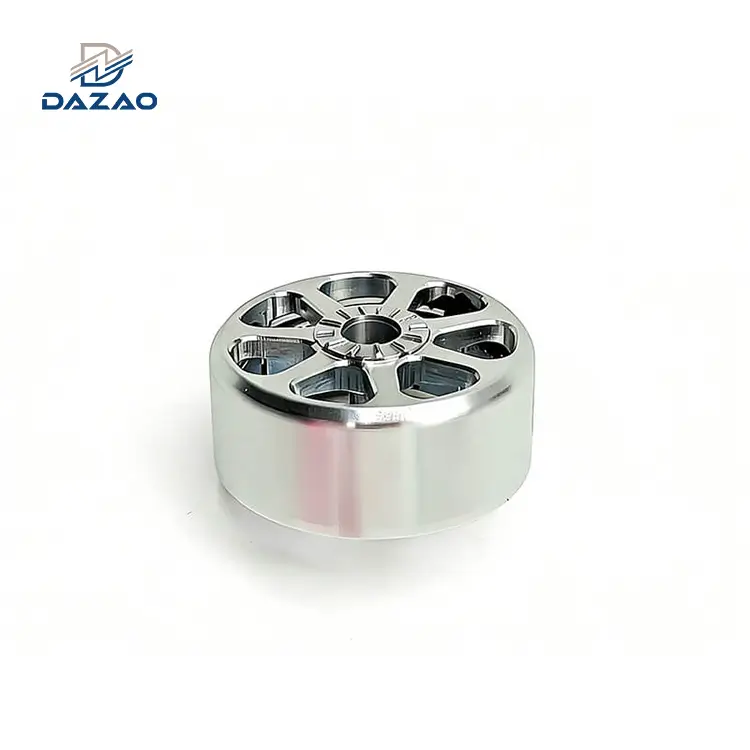
A Vinyl Record Weight Stabilizer (Record Weight / Turntable Weight) primarily helps:
- Increase the record's rotational inertia
- Stabilize speed (33⅓ / 45 rpm)
- Reduce resonance between the record and platter
- Improve low-frequency control and overall clarity
Key engineering principles:
Moment of Inertia Distribution (Affects Speed Stability)
A high-quality weight must achieve proper mass distribution between the center and outer rim to ensure smooth rotation.
Dynamic Balance (Affects Vibration Level)
Excessive eccentricity can cause:
Noise;
Additional bearing load;
Long-term mechanical wear;
We control eccentricity to ≤ ±0.05 mm in mass production.
Damping Design (Affects Resonance Suppression)
Material and structure determine low-mid frequency resonance decay.
Weight vs. Bearing Load Matching
Different turntables support different loads-weight selection must be verified (see specs table).
Why OEM Brands Must Use High-Quality Record Weights?
A record weight affects much more than sound-it is also a core differentiating accessory for OEM brands.
Sound Quality Improvement
More stable speed → lower noise floor → cleaner soundstage.
Reduce Compatibility Risks
Incorrect weight selection may damage bearings and lead to large-scale returns.
Commercial Value for Brands
Record weights are high-demand, high-margin accessories that help expand SKU portfolios.
Customization Capabilities
Logos, weight, diameter, and finishes help establish a professional brand identity.
Types & Structures of Record Weights: An OEM Selection Guide
By Structure:
|
Type |
Engineering Features |
Suitable Applications |
Our OEM Solutions |
|
Standard Record Weight |
Simple structure |
Mass OEM production |
Custom sizes, cost-effective |
|
Record Clamp |
Mechanical locking |
High-end audiophile use |
Precision threads, aluminum/steel |
|
Damping Weight |
Internal damping |
Studios, premium models |
Rubber rings, composite structures |
|
High-Inertia Design |
Mass distributed at outer edge |
Professional turntables |
Machined rim weights, dynamic balancing |
How Material Choice Affects Sound, Weight & Cost?
Different materials impact weight, damping, cost, and visual style.
|
Material |
Density |
Damping |
Cost |
Aesthetic |
Recommended Use |
|
Aluminum |
2.7 |
Medium |
Low |
Anodized, matte |
Best for mass OEM |
|
Stainless Steel |
7.8 |
High |
Mid-high |
Polished, mirror |
High-end market |
|
Brass |
8.5 |
Mid-high |
Mid-high |
Gold/Chrome plated |
Premium retail |
|
Acrylic |
1.2 |
Low |
Medium |
Clear, colored |
Lightweight aesthetic units |
Weight Selection Guide (Prevent Bearing Damage)
Weight affects:
Dynamic balance Bearing lifespan Sound quality Turntable compatibility
Recommended Weight Ranges
|
Weight |
Recommended Use |
Engineering Note |
|
150–250g |
Entry-level turntables |
Low bearing load |
|
250–450g (most common) |
70% of mainstream turntables |
Best stability & lifespan balance |
|
450–900g |
Professional turntables |
Bearing load must be verified |
Why CNC Machining Precision Determines Sound Performance?

A high-quality stabilizer must meet:
· Center hole tolerance: ±0.03 mm
· Dynamic balance eccentricity: ≤ ±0.05 mm
· Roundness & concentricity: CNC-controlled
· Surface roughness: Ra < 0.8 μm (prevents record scratches)
We provide:
· Dynamic balance test reports
· Dimensional inspection reports
· Ensuring consistent quality for every batch.
Our Compatibility Testing Procedure
|
Test Item |
Purpose |
Our Testing Support |
|
Spindle fit (7.2 ±0.1 mm) |
Ensure no wobble or scratching |
Custom sizes available |
|
Dust cover clearance |
Avoid hitting the cover |
3D drawings included |
|
Bearing load |
Prevent long-term wear |
Continuous rotation test |
|
Belt-drive vs. Direct-drive |
Validate compatibility |
Full-model test support |
We can test all your turntable models and provide reports + samples.
OEM/ODM Customization & Supply Chain Support
We provide full customization for brands.
Core Parameter Customization
Weight
Diameter
Internal structure
Damping design
Appearance Customization
Anodizing
Brushed finish
Gold/Chrome plating
Laser-engraved logo
Packaging & Mass Production
Retail gift boxes
Multi-SKU management
Batch deliveries
Supply Chain Assurance
ISO9001-certified factory
100+ CNC machines
Full QC: raw material → machining → finishing → packaging
Technical Specifications Table
|
Item |
Specification |
|
Diameter |
60–85 mm (customizable) |
|
Height |
25–45 mm |
|
Weight |
150–900 g |
|
Material |
Aluminum, stainless steel, brass, acrylic |
|
Center hole |
7.2 mm (customizable) |
|
Eccentricity |
≤ ±0.05 mm |
|
Surface finish |
Anodized / Brushed / Plated / Sandblasted |
|
Logo |
Laser engraving / Screen printing |
Frequently Asked Questions
Q1: What is the best weight for a Vinyl Record Weight Stabilizer?
250–450g works for most turntables, but verify bearing load first.
Q2: Is heavier always better?
No-excessive weight may damage bearings.
Q3: Difference between a Record Clamp and Record Weight?
A clamp locks the record; a weight provides rotational stability.
Q4: Aluminum vs. Stainless Steel-Which sounds better?
Stainless steel offers better damping; aluminum has better cost-performance.
Q5: Does a record weight damage vinyl?
No-our center hole is burr-free with Ra < 0.8 μm.
Q6: Can you customize colors?
Yes-anodizing, plating, sandblasting, transparent acrylic.
Q7: What is your MOQ?
100 pcs for standard models; 500 pcs for custom builds.
Q8: Can you provide dynamic balance reports?
Yes-for every batch.
Q9: Can you engrave logos?
Laser engraving and screen printing are available.
Q10: Can you provide multiple weight samples for comparison?
Yes-3–5 free samples.
Q11: Is it suitable for direct-drive turntables?
Yes-weight confirmation required.
Q12: Do you support retail packaging?
Yes-custom gift boxes available.
Contact Us Now for Free Samples,OEM Pricing,Technical Drawings