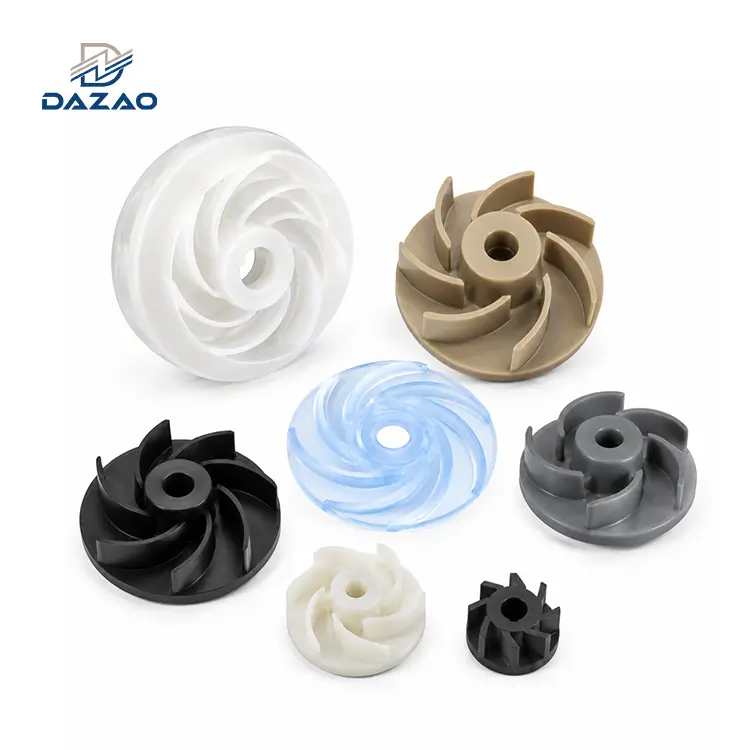
Precision Machined Plastic Impellers for High Velocity Fluid Pumps
Low-friction fluid dynamics engineered with G2.5 dynamic balance and zero molding lead time.
Core Engineering Features:
Custom CNC plastic impellers machined with 5-axis setups.
Machined PEEK pump impellers with G2.5 dynamic balance.
Chemical resistant plastic impellers with zero tooling.
PVDF closed impeller manufacturing within ±0.01mm runout.
High speed plastic turbine impellers via 5-axis milling.
Precision machined POM impellers for water filtration.
FDA approved plastic impellers for medical and food lines.
CNC prototyping for plastic impellers within 3 days.

5-Axis CNC Plastic Impellers: Machining Capabilities & Design Configurations
Engineered flow paths designed to mitigate hydrodynamic resistance and mechanical vibration.
Xiamen Dazao Machinery provides high-precision custom CNC plastic impellers designed for challenging fluid handling applications. Our facility processes semi-open, open, and closed-impeller geometries using multi-axis machining centers. By utilizing high-grade engineering polymers including Victrex PEEK, PVDF, POM, and carbon-reinforced nylons, we process high-grade engineering polymers into high-durability impellers for chemical metering pumps, medical dialysis equipment, and high-velocity fluid treatment systems.
Our manufacturing focus addresses three common engineering pain points in plastic impeller performance: internal stress deformation, dynamic imbalance at high rotational speeds, and blade-profile dimensional deviations. Through 5-axis machining and automated balancing processes, we manufacture high-performance alternatives to injection-molded impellers without the upfront cost or physical limitations of molds.

Fluid Dynamics Failure Analysis: Correcting Plastic Impeller Material and Machining Defects
Real-world performance reviews demonstrating our failure analysis and corrective engineering.
To illustrate our commitment to physical verification and engineering transparency, the following technical case studies document past manufacturing failures and the precise process corrections implemented to prevent recurrences.
Case 1: Dimensional Deformation in PVDF Closed Impellers for Acid-Transfer Pumps
· The Problem: An industrial chemical pump client in the United States ordered a batch of 1,200 PVDF closed impeller manufacturing units. After 60 days of ocean shipping and field service, approximately 17% of the impellers exhibited dimensional creep and warpage. This deformation caused severe dynamic unbalance, leading to shaft vibration, premature mechanical seal failures, and subsequent line shutdowns.
· The Root Cause Analysis: The raw PVDF stock was machined directly in its as-extruded state without stress-relief treatment. Semi-crystalline fluoropolymers like PVDF retain high internal stresses from extrusion. During ocean transit and operational temperature fluctuations, these internal stresses relaxed, causing asymmetric physical deformation.
· The Engineering Resolution: We established a mandatory 3-step thermal annealing protocol for all semi-crystalline polymers. Material stock is heated at a controlled rate, held at a specific thermal stabilization plateau, and slowly cooled inside the furnace. We also introduced 100% dynamic balance validation. The dimensional drift rate in subsequent batches dropped to under 0.2%.
Case 2: Hydrodynamic Efficiency Drop and Bio-Contamination in Pure PEEK Dialysis Impellers
· The Problem: A medical equipment manufacturer in Germany rejected 3,000 pure PEEK impellers intended for centrifugal blood-dialysis pumps. The parts failed on two criteria: a 11% reduction in hydraulic flow efficiency compared to the CAD model, and biological contamination during cytotoxicity testing.
· The Root Cause Analysis: To avoid complex setups, we originally processed the impellers on a 3-axis CNC using secondary manual flipping operations. The cumulative error between the two setups resulted in a 0.12mm blade profile deviation, altering the flow geometry. Furthermore, standard cutting fluids and ambient workshop oils left chemical residues that could not be fully removed with standard post-machining washes.
· The Engineering Resolution: We moved all medical-grade PEEK impeller orders to a dedicated 5-axis machining center, completing all complex blade profiles, bores, and hub features in a single clamping operation to limit cumulative error to ≤0.03mm. Additionally, we established a clean machining cell that utilizes DI water mist as a coolant and includes post-machining ultrasonic cleaning in an ISO-classified environment. This approach resolved biocompatibility issues and held hydraulic performance within ±2% of nominal specifications.
Case 3: Fatigue Fracture of Fiber-Reinforced Nylon Impellers in Industrial Desalination Systems
· The Problem: An Australian water filtration plant experienced structural failures with 500 reinforced nylon pump impeller machining units. Within 90 days of operation at 3,600 RPM, approximately 23% of the impellers suffered fatigue fractures at the junction where the blade roots meet the main hub shroud.
· The Root Cause Analysis: The original design utilized a glass-fiber reinforced PA6 material with standard sharp 90-degree internal root fillets. Finite Element Analysis (FEA) confirmed that cyclic mechanical loading generated severe stress concentrations at these sharp corners. Under constant centrifugal load, the PA6-GF matrix experienced micro-cracking and eventual structural fatigue.
· The Engineering Resolution: We transitioned the component material to Victrex PEEK 450FC30 (30% carbon fiber, PTFE, and graphite-reinforced). Working with the client's engineering team, we modified the CAD geometry to replace the sharp internal corners with a progressive fillet radius based on stress distribution curves. This change reduced localized stress concentration by 40% and improved structural fatigue resistance by more than 2.5 times under continuous load.

Engineering Specifications: Dimensional Tolerances and Material Grades for Machined Impellers
Metrology-backed tolerances and physical properties across our polymer stock.
Our CNC plastic impeller manufacturing ranges from 15mm to 350mm in diameter, held to strict mechanical tolerances:
|
Parameter |
Metric Specification |
English / Imperial Specification |
Validation Metrology |
|
Machining Diameter Range |
15 mm to 350 mm |
0.590" to 13.780" |
Calibrated Digital Calipers |
|
Blade Profile Tolerance |
±0.03 mm |
±0.0012" |
3D Laser Scanning / CMM |
|
Bore & Shaft Concentricity |
≤0.01 mm |
≤0.0004" |
Air Gaging / High-Precision CMM |
|
Surface Finish (Roughness) |
Ra 0.4μm to Ra 0.8μm |
16μin to 32μin |
Contact Profilometer |
|
Dynamic Balancing Grade |
ISO 1940 G2.5 |
ISO 1940 G2.5 |
Dynamic Balancing Rig |
|
Minimum Wall Thickness |
0.8 mm |
0.031" |
Ultrasonic Thickness Gauge |

Comparative Analysis: CNC Machining vs Injection Molding for Plastic Impellers
Cost-effective small-batch production bypassing tooling fees and material density anomalies.
For low-to-medium production volumes and complex prototype validation, multi-axis CNC machining offers several technical advantages over traditional injection molding:
· Zero Tooling Capital Expenditure: Eliminates the need for expensive steel molds, allowing clients to allocate budgets toward material selection and functional fluid testing.
· Structural Material Density: Extruded and annealed plastic bar stock is free of the internal voids, weld lines, sink marks, and micro-porosities common in injection-molded plastic parts.
· Unconstrained Geometry: Multi-axis CNC milling enables deep undercuts, complex reverse-curve blades, and closed impellers that cannot be released from an injection mold.
· Rapid Design Iteration: Modifying a blade angle or hub diameter requires only an update to the CAM program rather than modifications to a hard tool, reducing development cycles.

Polymer Selection Matrix: Stress Boundaries for Chemical Resistant Impellers
Operational limits and chemical compatibilities to prevent structural degradation.
Selecting the proper polymer is essential for preventing premature impeller failures in corrosive or high-stress environments. Below are the design limitations and application boundaries for our four primary materials:
1. POM (Polyoxymethylene / Acetal)
· Properties: Excellent dimensional stability, low moisture absorption, high stiffness, and low coefficient of friction.
· Ideal Applications: Non-corrosive water pumps, domestic water filtration, and low-pressure fluid transport.
· Engineering Limitations: Unstable in acidic or highly alkaline media. It is limited to a pH range of 4.0 to 9.0 and should not be used in fluid environments with operating temperatures exceeding 80°C.
2. PVDF (Polyvinylidene Fluoride)
· Properties: Highly resistant to strong mineral acids, halogens, and solvents. Excellent UV resistance.
· Ideal Applications: Industrial chemical pumps, acid waste treatment, and chlorine dosing systems.
· Engineering Limitations: PVDF has moderate mechanical strength and is prone to creep under high continuous loads. It is not recommended for high-speed dynamic applications with operating temperatures exceeding 120°C.
3. Food/Medical Grade Pure PEEK (Polyetheretherketone)
· Properties: Excellent chemical resistance, high mechanical strength, biocompatibility, and low outgassing.
· Ideal Applications: FDA approved plastic impellers for food paste processing, medical fluid pumps, and high-purity pharmaceutical loops.
· Engineering Limitations: Pure PEEK is relatively expensive and displays high wear rates in abrasive or slurry-laden fluid media.

4. Victrex PEEK 450FC30 (30% Carbon Fiber, PTFE, Graphite Reinforced)
· Properties: High tensile strength, low thermal expansion coefficient, self-lubricating, and exceptional wear resistance.
· Ideal Applications: High speed plastic turbine impellers, metering pumps, and petrochemical fluid control systems operating up to 260°C.
· Engineering Limitations: The addition of carbon fiber makes this grade electrically conductive. It is not suitable for applications requiring electrical isolation.
Quality Assurance Protocols: G2.5 Dynamic Balancing and CMM Inspection
Rigorous physical inspection protocols ensuring baseline alignment with your exact design drawings.
To maintain part consistency and performance, our manufacturing process includes several quality control checkpoints:
1.Incoming Material Verification: Every raw batch of PEEK, PVDF, or POM undergoes ultrasonic material integrity testing and is supplied with manufacturer mill test reports.
2.In-Process Metrology: Critical hub-to-bore runout, blade height, and internal geometry are verified during production using air gauges and coordinate measuring machines.
3.100% Dynamic Balancing: Every impeller is balanced on a soft-bearing dynamic balancing rig to ISO 1940 G2.5 standards to prevent vibration at operating speeds.
4.Environmental Chamber Cycling: Selected production samples undergo 72-hour thermal cycling tests to confirm physical stability under expected operating temperatures.
5.Cleanroom Packaging: Food and medical-grade impellers are packed in an ISO Class 7 clean area, sealed in anti-static PE bags, and shipped in protective hard cases.

Industrial Applications: Multi-Sector Deployment of Engineered Plastic Impellers
Optimized impellers deployed across volatile chemical environments and sanitary medical lines.
Our OEM plastic impeller manufacturing services support fluid handling applications across several demanding industries:

Chemical Processing & Petrochemical Pumps
Custom impellers designed for aggressive acids, bases, and high-temperature organic solvents.

Medical Devices & Pharmaceutical Equipment
Biocompatible, autoclavable impellers used in medical dialysis machines and high-purity laboratory pumps.

Industrial Water Filtration & Desalination
High-strength, erosion-resistant impellers that resist corrosion in brackish water and salt-water reverse osmosis systems.

Food, Beverage & Dairy Processing
Compliant components designed for sanitary pumps, food processing lines, and dairy packaging systems.
FAQs

01.Can you reverse-engineer a plastic impeller from an existing physical sample?
02.How do you ensure plastic impellers do not deform during ocean transit and high-temperature service?
03.What are the material limitations of POM when used for chemical resistant plastic impellers?
04.Do you offer genuine Victrex PEEK 450FC30 material with traceability certifications?
05.What is the minimum order quantity (MOQ) for custom CNC plastic impellers?
06.How does G2.5 dynamic balancing benefit high speed plastic turbine impellers?
Optimize your fluid systems with high-precision custom plastic impellers.
Upload your 2D and 3D CAD files (STEP, IGS, or PDF) for a detailed Design for Manufacturability (DFM) review and a formal quote within 24 hours.
Contact Us

Hot Tags: plastic impellers,machined PEEK pump impellers,chemical resistant plastic impellers,PVDF closed impeller manufacturing