
When procurement budgets collide with idealized engineering drawings, production stalls. For procurement managers and hardware buyers in the robotics sector, balancing rapid product iteration cycles with strict BOM (Bill of Materials) constraints is a daily operational reality. However, when engineers release CAD files optimized purely for theoretical performance, the resulting quotes from a custom machining supplier in China often exceed financial viability.
In industrial forums like, shop floor operators frequently voice a common frustration: "If engineers knew how much a sharp internal corner costs in machine time, they'd add radii instantly." Yet, most conventional machine shops simply quote exactly to the print, ignoring the financial burn rate hidden within the geometry.
At Xiamen Dazao Machinery, our standard protocol mandates engineering intervention before a single chip is cut. This cost reduction case study details exactly how we applied structural DFM for robotics to reduce CNC machining cost by 30% for a warehouse automation startup, without compromising structural integrity or mechanical function.
The Robotics Manufacturing Challenge: Overpriced Al6061 Chassis Parts
Our client, an autonomous mobile robot (AMR) startup, submitted an Al6061-T6 central chassis plate for initial prototyping and subsequent low-volume production. The preliminary cost analysis flagged the component as commercially unviable. If manufactured exactly as drawn, the chassis would push the total assembly BOM 18% over the target market price.
An immediate geometric analysis revealed two primary manufacturing barriers:
1.Excessive Setup Requirements: The external geometry and secondary side-features dictated four separate physical orientation setups.
2.Restrictive Tooling Clearances: The internal pockets featured R1.0mm radii at a depth of 25mm.
Milling a 25mm deep pocket with an R1.0mm radius requires a 2mm diameter micro-endmill. The extended tool stick-out introduces severe deflection risks, forcing feed rates to drop to negligible speeds to prevent tool breakage and maintain the required ±0.05mm tolerance. For a scaling company, finding a reliable factory capable of executing this design at high volumes was mathematically impossible.
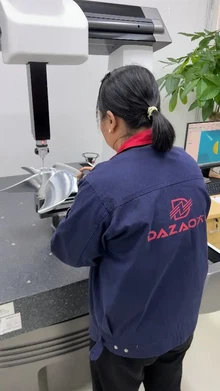
Dazao's DFM Solution: Reduce CNC Machining Cost Without Losing Functionality
To scale up production, aggressive DFM for robotics was mandatory. Our mechanical engineering team initiated a structural review with the client's design engineers to execute specific modifications.
Optimizing Internal Radii to Eliminate Micro-Tooling Breakage
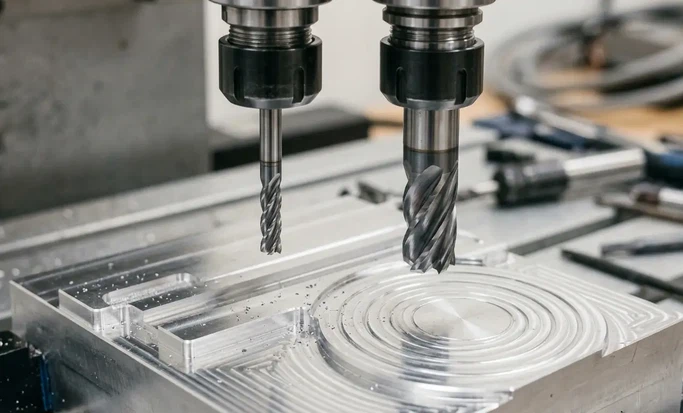
The deep internal pockets were designated for wire routing and PCB clearance-meaning the corners did not interface with sharp mating components. We restructured the internal corner radii from R1.0mm to R3.0mm.
This single geometric shift allowed our operators to utilize standard 6mm carbide endmills instead of fragile 2mm micro-tooling. The larger tool diameter facilitated aggressive chip evacuation and higher material removal rates (MRR). Spindle time decreased by exactly 40%, directly suppressing the hourly machine rate applied to the part.
Feature Consolidation to Minimize Machine Setups
The original CAD featured two M4 threaded holes on the lateral Y-axis face, used for mounting a non-critical sensor bracket. By collaborating with the client's assembly team, we relocated these mounting points to the primary top-Z plane and adjusted a 3-degree draft angle on an adjacent face.
This intervention downgraded the machining requirement from an expensive 5-axis CNC milling operation (or four manual 3-axis setups) to a standard 2-setup 3-axis routing.
|
Machining Metric |
Original CAD Design |
Dazao DFM Optimized Design |
Percentage Improvement |
|
Internal Radii |
R1.0mm |
R3.0mm |
200% Tool Rigidity Increase |
|
Required Setups |
4 (or 5-Axis) |
2 (Standard 3-Axis) |
50% Reduction |
|
Spindle Time/Part |
85 Minutes |
51 Minutes |
40% Reduction |
|
Tooling Breakage Risk |
High (Micro-tooling) |
Zero (Standard Tooling) |
100% Elimination |
3 Hidden CNC Machining Cost-Drivers Most Procurement Buyers Miss
While increasing radii and reducing setups are standard engineering practices, the underlying business mechanics affecting procurement are rarely discussed. Here are three systemic issues inflating your supply chain costs.
1. The Financial Trap of CAD Software "Default Fillets"
Many procurement officers are unaware that CAD software environments (like SolidWorks or Fusion360) apply default fillet values-often 1mm or 0.05 inches. Engineers frequently accept these defaults with a single click during the modeling phase, completely unaware that this specific dimension dictates the use of highly specialized, fragile tooling on the shop floor.
Engineering Directive: Procurement teams should mandate a "Default Fillet Check" from their engineering department before submitting STEP files to a factory. Eliminating arbitrary default fillets is the fastest way to reduce CNC machining cost by at least 10% before requesting a quote.
2. The Setup Multiplier Effect on Lead Times
Most literature notes that reducing setups saves money. However, for a Chief Procurement Officer, the more severe penalty is the destruction of production velocity. Every additional setup acts as a multiplier on lead time. One extra setup means designing one more custom fixture, executing one more First Article Inspection (FAI), and adding one more queue time bottleneck on the factory floor.
When scaling an order from 50 prototype units to 500 production units, setup counts become the hard ceiling on factory capacity. By restructuring the chassis to two setups, Dazao Machinery compressed the total manufacturing lead time from 4 weeks to 2.5 weeks.
3. Making "Supplier Pushback" a Core Procurement KPI
In supply chain communities like, a recurring grievance is that manufacturers simply quote blindly, fearing that rejecting a drawing will cost them the contract. A high-tier supplier must possess the engineering authority to say "No" to financially toxic geometry.
At Dazao Machinery, proactive DFM reporting is an ISO9001:2015 mandated workflow. If a submitted CAD file contains unnecessary cost premiums, we actively return the file with a marked-up DFM report. Procurement metrics should reward suppliers who push back on bad engineering, as this friction guarantees long-term manufacturing scalability.
Project Results: 30% Cost Reduction & Scalable Production
The implementation of these DFM principles transformed the Al6061-T6 chassis from an expensive bottleneck into a highly scalable, economically viable component.
|
Business Metric |
Before Dazao DFM |
After Dazao DFM |
Total Impact |
|
Unit Cost |
$145.00 |
$101.50 |
30% Reduction |
|
Production Lead Time |
28 Days |
18 Days |
35% Faster Delivery |
|
FAI Pass Rate |
82% (Estimated) |
100% |
Zero Defects |
|
Mechanical Strength |
Standard Baseline |
Identical |
No Functional Loss |
"Dazao Machinery did not just operate as our machine shop; they functioned as an external extension of our manufacturing engineering department. Their DFM analysis directly saved our BOM target for Q3." - Lead Hardware Engineer, Robotics Client.
Conclusion: Stop Paying the "Engineering Tax" on Custom Parts
In the hardware and robotics sector, physical profit margins are rigid. Utilizing engineered DFM to reduce CNC machining cost is not about cutting corners or downgrading material specifications; it is about applying intelligent manufacturing logic to subtract waste. If your current custom parts factory is executing your files without questioning the geometry, you are actively paying an engineering tax on every purchase order.

FAQ
01.Why do machinists on always complain about sharp internal corners?
02.Why do suppliers quote bad designs instead of offering DFM feedback?
03.How much do standard CAD "default fillets" actually cost in production?
04.Why is reducing machine setups more critical than raw machining time?
05.Does applying a blanket ±0.01mm tolerance ruin the manufacturing budget?
06.Why did my robotics prototype cost double when scaling to low-volume production?