
A Buyer's Guide to Cost, Scaling, and Hidden Pitfalls
For mechanical engineers and procurement directors sourcing custom metal components in 2026, the decision matrix has shifted. Binder Jetting and next-generation Direct Metal Laser Sintering (DMLS) deliver higher deposition rates and lower material costs. Simultaneously, multi-axis machining centers powered by AI-assisted CAM and automated robotic tending maintain heavy advantages in high-volume cycle times.
To make an objective supply chain decision, buyers need a data-driven CNC vs 3D printing cost comparison. Single-unit quotes from a supplier often mask the true manufacturing break-even point. Based on 2026 production data from our ISO9001:2015 and IATF16949:2016 certified facility at Xiamen Dazao Machinery, this engineering brief breaks down the exact cost structures for 5, 50, and 500 metal parts, exposing the hidden expenses most manufacturers will not disclose.
Frontline Engineering Reality: Procurement Complaints vs. Marketing Hype
Before analyzing the numbers, it is necessary to examine field data. Hardware engineers and supply chain managers on platforms like Multiple renowned community forums consistently highlight specific procurement failures when choosing between these processes.
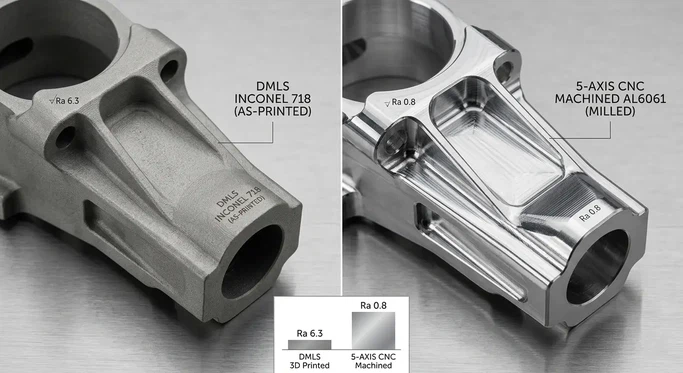
· The "Ready-to-Use" Myth: A common complaint from buyers involves surface finish. One hardware engineer noted, "Sales reps claim DMLS parts are ready to assemble. We procured a batch of 316L stainless steel gears. The as-printed surface roughness was Ra 6.3. We had to send the entire batch to a custom CNC factory to interpolate the mating surfaces to Ra 0.8, destroying our initial cost savings."
· Tolerance and Thermal Distortion: In metal additive manufacturing, rapid heating and cooling cycles introduce residual stresses. Buyers report that warping during the build process causes unacceptable scrap rates on tight-tolerance geometric features, transferring the cost burden back to the final per-unit price.
· Miscalculated Setup Costs: Historically, CNC machining required high Non-Recurring Engineering (NRE) costs for fixturing and CAM programming. In 2026, automated zero-point workholding systems and generative toolpath algorithms have drastically reduced the setup time for medium-complexity parts, challenging the assumption that machining is strictly for high volumes.
Volume Scaling Analysis: True Cost Breakdown for 5, 50, and 500 Metal Parts
To establish an accurate CNC vs 3D printing cost comparison, we must isolate production volume.
1. Proof of Concept (1-5 Units): The NRE Cost Advantage of Additive Manufacturing
For volumes under 10 units, metal 3D printing dominates. The process requires zero custom workholding, no specialized cutting tools, and minimal CAM setup. It is the optimal method for components with internal conformal cooling channels or topology-optimized geometries.
Conversely, CNC machining 5 parts absorbs the entire NRE cost across a small batch. Unless the geometry is a basic cylindrical or prismatic block, the per-part cost for machined prototypes remains structurally high.
2. Low-Volume Production (50 Units): The Machining Break-Even Battleground
At 50 units, the cost delta in metal 3D printing vs machining narrows, establishing the 2026 break-even zone. Material selection becomes the primary cost driver here.
· For highly machinable alloys like Al6061-T6, CNC cycle times are short, tool wear is minimal, and machining becomes the cheaper option at 50 units.
· For hard-to-machine superalloys like Ti-6Al-4V or Inconel 718, 3D printing retains its economic advantage. Additive manufacturing generates near-zero material waste and eliminates the severe cutting tool degradation associated with milling titanium.
3. Scaled Production (500+ Units): Machine Tending and Cycle Time Efficiency
At 500 units, CNC machining achieves maximum economic efficiency. Multi-pallet 5-axis machines run unattended. The initial setup cost is amortized across 500 units, reducing its impact to pennies per part. Cycle times strictly dictate the price, which drops exponentially.
For metal 3D printing, the cost curve flattens. While multi-laser systems increase build speeds, the high cost of atomized metal powder and the fixed build-plate time prevent the per-unit cost from dropping significantly. A 500-unit additive run is simply 10 consecutive 50-unit runs.
Process Comparison Matrix: DMLS vs. 5-Axis Milling (Based on 50 Units)
|
Parameter |
CNC Machining (5-Axis) |
Metal 3D Printing (DMLS) |
Winner at 50 Units |
|
Setup Cost (NRE) |
High ($300 - $800) |
Low ($50 - $100) |
3D Printing |
|
Material Cost |
Low (Billet/Extrusion) |
High (Atomized Powder) |
CNC Machining |
|
Tolerance Capability |
Tight (±0.001" / 0.025mm) |
Moderate (±0.005" / 0.125mm) |
CNC Machining |
|
Material Waste |
High (Subtractive) |
Low (Additive) |
3D Printing |
|
Titanium/Inconel Cost |
Very High (Tool wear, slow feed) |
Moderate (Standard laser melt) |
3D Printing |
|
Aluminum Cost |
Very Low (High-speed milling) |
High (Powder cost) |
CNC Machining |
The Dazao 2026 Custom Manufacturing Break-Even Chart
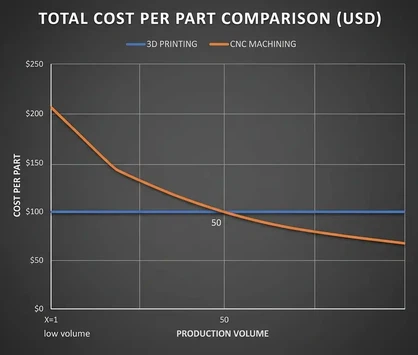
When plotting these variables, we generate the manufacturing break-even chart.
· The Y-Axis (Cost Per Part) and X-Axis (Volume 1-1000).
· The 3D Printing Curve starts extremely low on the Y-axis but descends at a shallow angle, quickly becoming a horizontal line representing fixed material and machine-hour costs.
· The CNC Machining Curve begins high on the Y-axis due to setup fees but drops sharply downward, forming a hyperbolic curve as volume scales.
In 2026, the exact intersection point of these two curves typically falls between 30 and 80 units. If your production volume sits to the left of the intersection, print it. If it sits to the right, machine it. As an experienced manufacturer in China, Dazao inputs your specific CAD geometry, material density, and target tolerances into our proprietary quoting engine to pinpoint the exact unit count where this X-intersection occurs.
3 Hidden Procurement Costs Most Metal Suppliers Ignore
Standard quoting algorithms often ignore the physical realities of the factory floor. Accurate supply chain forecasting requires accounting for three hidden variables.
1. The "As-Printed" Fallacy: Factoring in Hybrid CNC Post-Processing
Vendors frequently present these technologies as an either-or choice. The physical reality for precision engineering is Hybrid Manufacturing. Almost 100% of functional metal 3D printed components require secondary CNC machining. Critical bearing journals must be precision-turned, threads must be tapped, and mating flanges must be faced.
When calculating additive costs, buyers must add the "CNC post-processing cost." Selecting a manufacturer like Dazao, which houses both multi-laser additive arrays and 5-axis CNC centers under one roof, eliminates the margin-stacking and logistical delays of outsourcing secondary operations.
2. Material Certification Traps: NDT Testing for DMLS Porosity
CNC machining relies on standardized, wrought, or extruded metal billets. The mechanical properties (yield strength, tensile strength) are uniform, isotropic, and backed by standard mill certificates.
Metal 3D printing builds parts layer by layer, introducing potential micro-porosity and anisotropic mechanical properties (Z-axis weakness). If sourcing parts for aerospace or medical device applications, strict validation is mandatory. The added cost of non-destructive testing (CT scanning) and destructive tensile testing on printed witness coupons can easily double the total project cost for a 50-unit batch.
3. Total Cost of Ownership (TCO): Capital Tie-up vs. Digital Inventory
Procurement directors must look beyond the single-unit Bill of Materials (BOM) price. If a buyer procures 500 CNC machined parts to secure a lower per-unit price, but their annual consumption rate is only 50 units, they incur capital tie-up, warehousing costs, and inventory obsolescence risks on the remaining 450 units.
In highly variable demand cycles, accepting a slightly higher per-unit cost for a 50-unit 3D printed batch facilitates an "On-Demand Digital Inventory," resulting in a lower Total Cost of Ownership.
Conclusion: Securing a Data-Driven Supply Chain in 2026
In 2026, neither process holds a universal economic advantage. The true manufacturing break-even point is a multivariable equation dictated by part geometry, alloy type, tolerance requirements, and exact production volume. Relying on generalized assumptions leads to inflated BOM costs and extended lead times.
As a unified custom manufacturing facility equipped with top-tier CNC machining centers and industrial additive manufacturing systems, Dazao maintains strict process neutrality. We do not force your geometry into a specific machine; we assign the machine that mathematically yields the lowest cost and highest precision for your specific requirements.

FAQ
01.Why can't I use metal 3D printed parts directly off the printer?
02.How does thermal warping in metal 3D printing affect final procurement costs?
03.Are CNC setup costs still too high for small 50-unit batches in 2026?
04.What hidden testing costs should buyers expect with DMLS printed metal parts?
05.Why doesn't the per-unit cost of 3D printing drop significantly at 500 units?
06.What is the most cost-effective way to source tight-tolerance metal prototypes?