
Specifying the wrong austenitic grade on an engineering drawing frequently leads to budget overruns, broken tooling, or catastrophic assembly failure in the field. When comparing 303 vs 304 stainless steel, or evaluating the necessity of 316 for a project, mechanical engineers and procurement officers must look beyond basic material data sheets. Real-world manufacturability dictates the final piece price and lead time.
At Xiamen Dazao Machinery, an ISO9001:2015 and IATF16949:2016 certified source factory operating since 2000, we analyze thousands of CAD files annually. This engineering memo extracts decades of CNC machining data to define the precise technical boundaries between the 303, 304, and 316 grades. We will analyze machinability, weldability, and total cost of ownership to help you lock in the correct material specification.
Core Differences: Machinability, Weldability & Corrosion Resistance
Understanding the metallurgical differences among these three austenitic grades is mandatory for effective Design for Manufacturability (DFM).
Technical Parameter Matrix
|
Grade |
Machinability Index |
Weldability |
Corrosion Resistance Level |
Primary Alloy Additions |
Relative Material Cost |
|
303 |
78% (Excellent) |
Poor (Hot Cracking) |
Moderate |
Sulfur (S) or Selenium (Se) |
1.0x (Baseline) |
|
304 |
45% (Fair) |
Excellent |
High |
Standard Cr-Ni |
0.9x |
|
316 |
36% (Challenging) |
Excellent |
Very High |
Molybdenum (Mo) 2-3% |
1.3x - 1.5x |
1. Chemical Composition & Material Parameter Matrix
All three alloys belong to the 300-series austenitic stainless steel family, meaning they share a core structure of Chromium (approx. 18%) and Nickel (approx. 8%). The variations in trace elements dictate their specific industrial applications.
2. The 303 Paradox: High Machinability, Zero Weldability
Engineers frequently specify material 303 stainless steel for high-volume screw machine parts. The defining characteristic of 303 is the deliberate addition of Sulfur (minimum 0.15%) or Selenium.
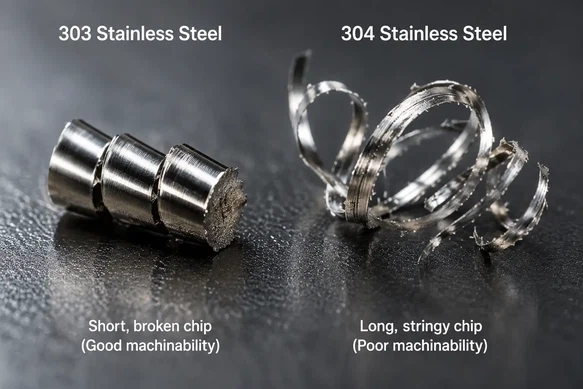
During the CNC turning process, these sulfur additions form manganese sulfide inclusions. These microscopic inclusions act as internal lubricants and force the metal chips to break cleanly rather than forming long, stringy bird nests around the cutting tool. However, this same sulfur content makes 303 virtually un-weldable. During TIG or MIG welding, the sulfur melts faster than the base metal, leading to severe hot cracking. The weld pool becomes highly compromised, frequently splitting apart as it cools down to room temperature.
3. 303 vs 304 Stainless Steel: The Versatility & Tool Wear Battle
When evaluating 303 stainless steel vs 304, the core difference is sulfur. Grade 304 contains a maximum of 0.03% sulfur. This lack of sulfur guarantees excellent weldability and higher overall toughness. However, the absence of chip-breaking inclusions means 304 is highly gummy during CNC milling and turning. The chips do not break easily, generating immense heat at the cutting edge and requiring high-pressure coolant systems to prevent built-up edge (BUE) on carbide inserts.
4. 304 vs 316 SS: The Truth About Stainless Steel Corrosion Resistance
The passive chromium oxide layer protects these alloys from oxidation. The hierarchy of stainless steel corrosion resistance progresses from 303 to 316.
Grade 303 has the lowest resistance due to its sulfur inclusions, which create micro-gaps in the passive layer. Grade 304 provides the standard baseline, resisting most organic chemicals and normal atmospheric environments.
When analyzing 304 vs 316 stainless steel, the differentiator is Molybdenum. Grade 316 contains 2% to 3% Molybdenum, providing specific resistance against pitting and crevice corrosion in chloride environments, such as seawater or industrial de-icing salts.
Real-World Engineering Pain Points
Real-world feedback from hardcore machining forums highlights the severe disconnect between print specifications and shop floor reality.
The 304 Machining Nightmare: Severe Work Hardening
A dominant complaint among CNC programmers regarding 304 is its tendency for extreme work hardening. If the feed rate on a CNC lathe or mill is too low, the cutting tool rubs against the material instead of cutting it. This physical friction hardens the surface layer of the 304 part to a rock-like consistency instantly. When the next tool, such as a high-speed steel tap, hits this hardened layer, it shatters.
Procurement Actionable Insight: If your part requires heavy internal threading or deep hole drilling, and does not require welding, forcing your supplier to use 304 will inflate your cycle time and increase your tooling surcharge.
The 316 Surgical Steel Machining Myth: Wasted Budgets
Mechanical engineers often over-spec materials to be safe. It is highly common to see 316 surgical steel machining specified for internal electronic enclosures or dry-environment robotic arms.
Procurement Actionable Insight: When buyers ask for a comparison of 304 vs 316 ss, they must evaluate the environment. Using 316 for a dry indoor component simply burns budget. The raw material cost of 316 is roughly 30% to 50% higher than 304, and its lower machinability rating further extends CNC cycle times. However, if complex aerospace or medical geometries truly require 316, utilizing a highly rigid 5-axis CNC milling process is mandatory to control severe tool wear and ensure strict tolerances.
Welders' Despair: Attempting to TIG Weld 303
Manufacturing forums regularly feature posts from junior welders displaying cracked, porous weldments asking for troubleshooting advice. Veteran fabricators immediately identify the root cause: someone tried to weld 303.
3 Hidden Manufacturing Costs (Dazao Procurement DFM Guide)
Standard material specification sheets omit critical data that affects your bottom line. Based on Xiamen Dazao Machinery's extensive IATF16949 audit data, here are three operational realities you must consider.
Total Cost of Ownership (TCO): Raw Material vs. Cycle Time
Many procurement platforms show that raw 304 bar stock is marginally cheaper per kilogram than 303. Buyers frequently switch prints from 303 to 304 to save raw material pennies.
In high-volume CNC turning of shafts or custom fasteners, the 303 vs 304 stainless steel cost equation flips entirely. Grade 303 allows for spindle speeds 30% to 50% faster than 304. The rapid chip evacuation reduces tool wear significantly. The labor and machine-hour savings generated by 303 entirely offset its slightly higher raw material cost. For complex, non-welded parts, 303 yields a lower Total Cost of Ownership.
Steel Mill Batch Variance: The Gummy 304 Effect
Engineers assume all 304 performs identically. In reality, international ASTM standards allow a percentage range for Nickel and Chromium. Steel mills frequently aim for the absolute lower limit of expensive elements like Nickel to maximize their profit margins.
If a batch of 304 hits the lowest allowable metallurgical limits, its machinability drops drastically, becoming exceedingly gummy. Xiamen Dazao Machinery enforces strict Incoming Quality Control (IQC) protocols, requiring complete material test reports (MTRs) and conducting sample machinability tests to guarantee stable tolerances, something lower-tier factories fail to control.
Surface Treatment Limits: Why 303 Fails Acid Passivation
Discussions regarding 304 stainless steel vs 316 often focus on raw rust prevention, ignoring post-machining surface treatments.
If your part requires a high-gloss mirror polish or strict nitric acid passivation (per ASTM A967), 303 is a severe liability.
The sulfur inclusions that make 303 stainless steel easy to machine will dissolve during acid passivation. This dissolution leaves microscopic pits across the part's surface, a defect known as frosting. For medical-grade finishes or high-purity vacuum applications, you must use 304 or 316, regardless of the machining difficulty.

Material Selection Decision Tree for Custom CNC Parts
To optimize your supply chain and prevent engineering failures, apply this strict material selection logic:
Specify 303 Stainless Steel if:
· The part requires heavy CNC milling, turning, deep hole drilling, or tapping.
· The design absolutely dictates zero welding.
· The operating environment is dry or exposed to mild atmospheric conditions without harsh chemicals.
· Common applications: Precision electronic standoffs, non-welded shafts, custom aerospace fasteners, sensor housings.
Specify 304 Stainless Steel if:
· The manufacturing process requires bending, forming, or TIG/MIG welding.
· The component operates outdoors or in standard wet environments.
· You require a good balance of strength, weldability, and moderate cost.
· Common applications: Food processing brackets, welded structural frames, standard automotive trim.
Specify 316 Stainless Steel if:
· The component faces severe chloride exposure (marine environments, coastal installations, de-icing salts).
· The drawing strictly requires 316 surgical steel machining for medical devices or pharmaceutical fluid handling.
· The part functions within chemical processing plants involving corrosive acids.
· Common applications: Marine boat fittings, chemical pump impellers, surgical instruments, high-pressure valves.
Optimize Your CNC Machining Strategy with Xiamen Dazao
Selecting the correct austenitic grade requires balancing mechanical yield strength, thermal conductivity, cycle time, and raw material indexing. An over-specified part wastes capital; an under-specified part causes system failure.
At Xiamen Dazao Machinery, our engineering team executes rigorous DFM analysis to align your CAD requirements with the most cost-effective manufacturing strategy. Whether you need the rapid cycle times of 303 for high-volume fasteners, the weldability of 304 for complex assemblies, or high-tolerance 5-axis machining for 316 aerospace components, our ISO-certified facility delivers strict dimensional compliance.

Frequently Asked Questions
01.Why do taps keep breaking when CNC threading 304 stainless steel?
02.Can I successfully TIG weld 303 stainless steel if I use a 308 filler rod?
03.Is 316 surgical steel machining required for indoor electronic enclosures?
04.Why does my 304 stainless steel part have a torn, gummy surface finish?
05.Will 303 stainless steel rust in a standard un-climate-controlled warehouse?
06.My procurement manager wants to switch from 303 to 304 bar stock to save raw material costs. Is this correct?