
In real-world purchasing decisions, CNC machining cost is rarely just about the number on the quote.
More often, it appears in a familiar scenario:
the project is already approved, drawings are finalized, and you're now choosing between several suppliers that seem to have "similar capabilities."
What creates hesitation isn't simply whether a price is high or low -it's why the same drawing can result in drastically different quotes from different suppliers.
Once you start asking that question, you're already moving toward a better decision- especially if you first understand what CNC machining is and how manufacturers actually evaluate production risk and cost.
Why Does the Same CNC Part Cost So Much More at Different Factories?
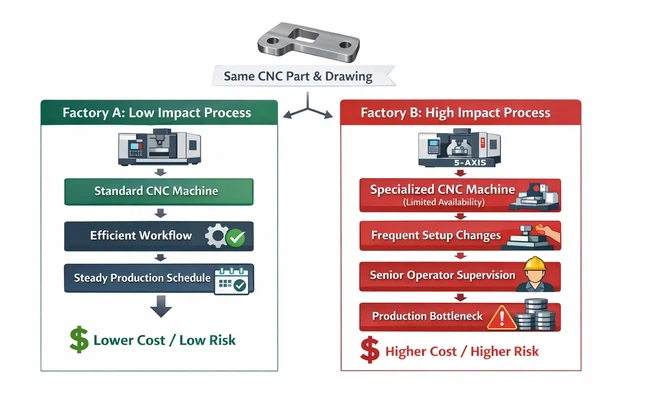
From a buyer's perspective, the part is fixed. The drawing is fixed.
From a factory's perspective, however, that part is not just a product - it's a variable entering their production system.
This distinction often becomes clearer once buyers understand what CNC machining is from a manufacturing standpoint rather than a purely purchasing one.
Some parts flow smoothly through standard machines, with predictable processes and stable scheduling.
Others disrupt production plans, occupy critical equipment, or require constant supervision from highly experienced operators.
Every factory has a different tolerance for these risks.
Price differences usually reflect how each manufacturer evaluates the impact of your part on their system, not arbitrary pricing.
How CNC Machining Materials Affect Cost Beyond Raw Material Price?
When comparing CNC machining costs, many buyers instinctively focus on material price.
But in manufacturing, the more important question is often not how much the material costs, but how well it machines.
Some materials cut cleanly and remain dimensionally stable, enabling consistent production.
Others - even if inexpensive - may cause thermal deformation, accelerated tool wear, or unstable yields.
These issues rarely appear as line items in a quote, but they are always factored into internal cost calculations.
The real value lies not in insisting on a specific material, but in identifying machining-friendly alternatives that still meet functional requirements.
How Raw Material Size and Inventory Compatibility Impact CNC Machining Cost?
This factor is rarely discussed openly during quoting, but it matters greatly on the shop floor.
If your part dimensions align with standard stock sizes, material utilization and preparation costs stay low.
If non-standard blanks are required, waste increases - along with cutting steps, inventory pressure, and handling time.
These costs may never be itemized, but they will appear in the final price.
It's often worth asking suppliers whether a more economical blank size can be used without affecting function or assembly.
Why Machining Time Is Always the Core Cost Driver?
No matter how large or advanced a factory is, CNC machining ultimately comes down to machine time allocation.
The more expensive or capacity-constrained the machine, the higher its time value.
Machining time includes far more than cutting alone - setup, alignment, tool changes, measurement, and rework allowances all contribute.
Some features that look simple on a drawing can be surprisingly time-consuming in practice.
Multiple reorientations and repeated calibration almost inevitably push costs upward.
Our CNC machining service is designed to minimize unnecessary setup time and production risk.

The Hidden Cost Impact of Multiple Setups
Setup count is rarely listed as a separate cost, yet it's a critical internal evaluation metric.
Each additional setup increases manual intervention and the risk of accumulated error.
For manufacturers, this isn't just about time - it's also about quality risk.
When a part cannot be completed with minimal setups, quotes naturally become more conservative.
Understanding Cost Differences Between 3-Axis, 4-Axis, and 5-Axis CNC Machining
Five-axis machining is often perceived as more advanced and more efficient.
In reality, higher-axis machines also come with higher operating costs.
Only when five-axis machining significantly reduces setups or enables otherwise impossible geometries does it offer a total cost advantage.
a CNC milling service that selects the machining strategy based on part geometry.
A better approach is not to specify machine type upfront, but to allow suppliers to choose the most stable and economical process based on the part itself.

How Tolerance Requirements Directly Increase CNC Machining Cost?
Tight tolerances are never free.
As tolerances tighten, machining speed decreases, inspection frequency increases, and scrap risk rises.
Many designs default to overly strict tolerances that exceed actual functional needs.
Separating critical dimensions from non-critical ones is one of the most effective ways to control CNC machining cost without compromising performance.

The Real Cost Impact of Surface Finishing and Secondary Processes
In many custom projects, machining itself is not the most expensive part.
High cosmetic requirements often drive cost increases due to lower defect tolerance, higher rework rates, and stricter quality screening.
Clarifying early whether a part is functional or appearance-critical has a decisive impact on total cost control.
How CNC Machining Cost Is Actually Calculated in Production?
Real CNC pricing combines fixed investments and variable costs.
Programming, fixturing, and first-article validation are particularly significant in low-volume production.
This explains why prototypes often carry higher unit prices, while costs drop as quantities increase.
Understanding this structure helps set more realistic budget expectations at each project stage.
Our CNC machining process accounts for programming, fixturing, and first-article validation upfront.a structured CNC machining workflow.
How Buyers Can Systematically Control CNC Machining Cost?
In the long run, cost control isn't about pushing prices down - it's about reducing uncertainty.
When machining paths are clear and quality expectations are well-defined, suppliers can quote more confidently and execute more reliably.
Mature projects tend to succeed because design intent, communication, and expectations are aligned from the start.
A Practical Perspective on CNC Machining Cost
CNC machining cost is not random, nor purely a result of negotiation.
It reflects a combined judgment of time, risk, and manufacturing behavior.
When you start evaluating quotes from a manufacturing perspective, the difference between price and value becomes much clearer.
Conclusion
Many cost disputes happen not because prices change, but because expectations were never aligned at the start.
If you're evaluating CNC machining costs for an upcoming project and want a realistic assessment based on your part design, you're welcome to share your drawings with our engineering team for a practical review.
FAQ
Q1: Why is my CNC machining quote much higher than expected?
In most cases, it's not due to material cost or margin, but because machining time, setup complexity, tolerance requirements, or risk factors exceed standard production conditions.
Q2: Is providing a 3D model enough, or do I still need 2D drawings?
3D models help explain geometry, but key dimensions, tolerances, and surface requirements must be defined in 2D drawings - otherwise quotes will include higher uncertainty buffers.
Q3: Why is unit pricing so high for low-volume CNC machining?
Because fixed costs like programming, fixturing, and first-article validation cannot be spread across quantity. This is typical in prototyping and pilot runs.
Q4: Should every part aim for the lowest possible CNC machining cost?
Not necessarily. For critical components, stability, delivery reliability, and consistency often matter more than the lowest unit price.
Q5: How can I prevent cost increases after the RFQ stage?
Clearly define functional requirements, critical tolerances, and surface standards during RFQ to enable accurate, executable quotes.
Q6: Can CNC machining cost be optimized without affecting functionality?
In many cases, yes - adjusting non-critical tolerances, material choices, or certain design features can significantly reduce machining difficulty.
Q7: Besides price, what should I evaluate when choosing a CNC supplier?
Manufacturing stability, communication efficiency, engineering understanding, and proven project experience often determine long-term total cost.