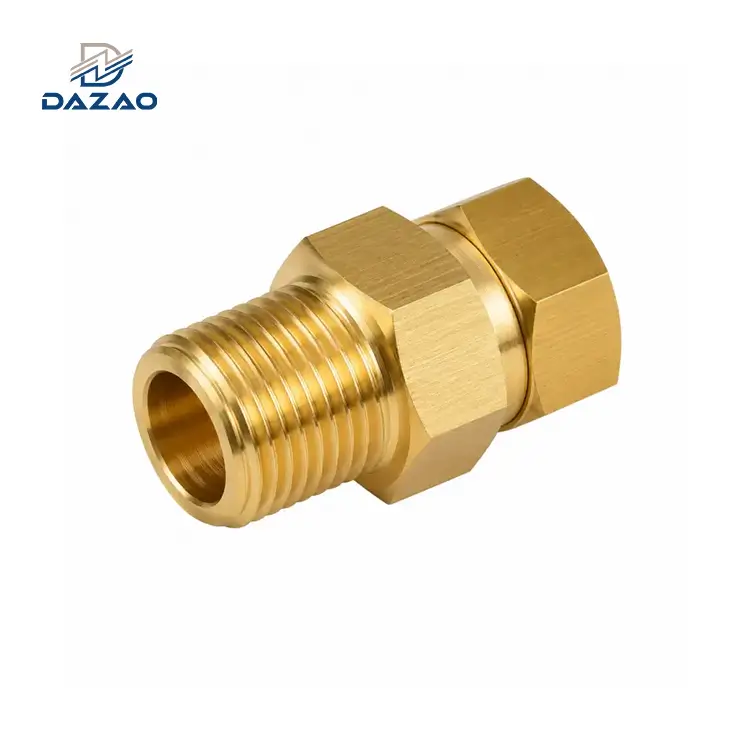
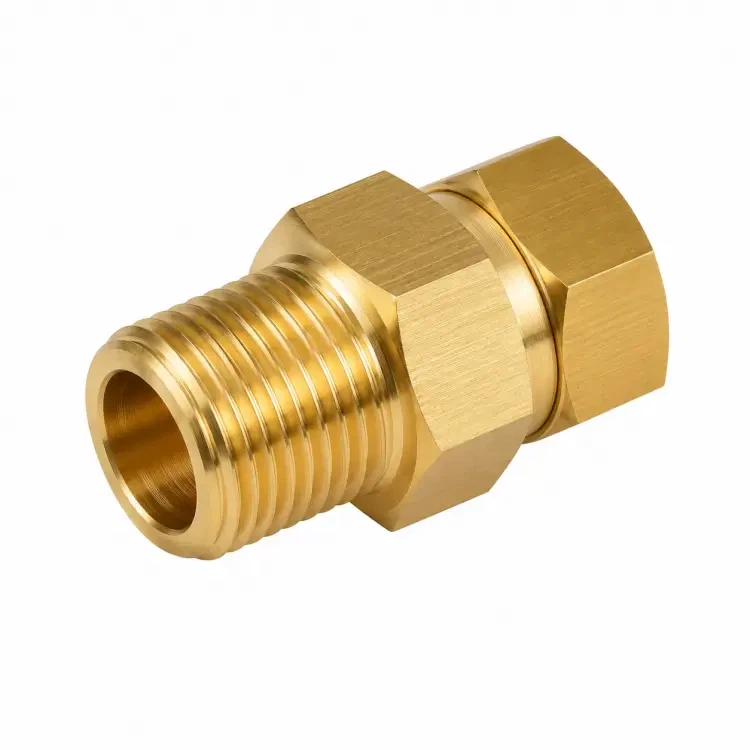
CNC Machined Brass Hydraulic Tube Fittings Manufacturer
Zero-leak fluid connectors engineered to ±0.01mm tolerances for high-pressure industrial applications.
Core Engineering Features:
±0.01 mm tolerance for high-pressure brass flare fittings.
Sealing taper angle deviation controlled within ±0.2°.
3-stage deburring for clean instrumentation brass tube fittings.
Turn-mill center processing ensures concentricity ≤0.02 mm.
Raw materials include H59, H62, and lead-free C3604 brass.
Rapid CNC brass hydraulic fitting prototyping within 7 days.
Full thread inspections with go/no-go gauges.
Custom Hydraulic Integration
Xiamen Dazao Machinery is a specialized contract manufacturer with 20 years of experience in CNC machining and turn-mill machining for heavy-duty brass fluid connectors. We support OEMs, hydraulic integrators, automotive tier-1 suppliers, and instrument manufacturers globally . Rather than relying on generic product catalogs, we manufacture custom fluid power connectors strictly according to your 2D and 3D CAD drawings.

Advanced Machining Capabilities for Brass Hydraulic Fittings
Multi-axis machining systems delivering high-integrity thread and taper profiles.
Standard brass adapters frequently suffer from hidden failure modes such as micro-leaks under high pressure, particle contamination in valve blocks, or structural misalignments during installation . Below are three actual case studies detailing how we modified our engineering processes to eliminate these defects.
Case Study 1: Resolving Taper Angle Deviation and High-Pressure Leaks in JIC Flare Joints
The Problem: During an early run of American standard JIC 74-degree flared brass connectors, we turned the sealing tapers using a standard tool-wear compensation interval . A delay in tool offset adjustments allowed the taper angle on a subset of parts to deviate by up to 0.5°, causing uneven contact pressure . When the customer subjected the assembled hydraulic lines to pressure testing, the system experienced a 15% leak rate at the joints, delaying equipment delivery.
The Resolution: We utilized precision CNC turning on our lathe centers to process the sealing tapers with a rigid tool-wear compensation protocol . Tool offsets are now recalculated automatically after a predetermined number of cycles. First-article inspections (FAI) are verified on a Coordinate Measuring Machine (CMM) . Thread and taper profiles undergo optical comparator verification, and finished parts are mirror-turned to achieve a surface roughness of Ra 0.8 . Subsequent production batches showed field leak rates below 0.1%.
Case Study 2: Eliminating Solenoid Valve Failures Caused by Micro-Burrs in Instrumentation Channels
The Problem: We supplied a batch of micro-sized brass adapters to an instrumentation customer for use in sub-miniature hydraulic control manifolds . Although standard external manual deburring was completed, microscopic burrs remained inside the cross-drilled internal passages. During the customer's final system calibration, approximately 20% of the control valves suffered from spool sticking . Investigation showed that micro-burrs had detached from the internal fluid channels and lodged in the tight clearances of the spool valves.
The Resolution: We implemented a hydraulic-grade 3-stage deburring process. Machined fittings now undergo a centrifugal barrel tumble, followed by an ultrasonic abrasive wash specifically targetted at internal passages, and a high-pressure pulsed air flush. We perform random quality audits using industrial borescopes to verify the complete absence of loose internal particles. Since establishing this protocol, the scrap rate due to valve clogging has been reduced to zero.
Case Study 3: Overcoming Concentricity Deviation and Vibration Failures in Hexagonal Connectors
The Problem: For a run of male-to-female hexagonal brass adapters, our original manufacturing workflow used a split process: turning and threading on a CNC lathe, followed by hexagonal milling on a separate manual milling machine. The secondary setup introduced a clamping error, which caused the thread axis to deviate from the hexagonal body centerline by up to 0.1 mm. During manual assembly, field operators used excessive wrench force to align the misaligned joints, creating uneven gasket loads. Over extended operational runtimes, system vibrations caused the fittings to back out and leak.
The Resolution: We moved all multi-featured connector orders to integrated CNC turn-mill centers. All turning, drilling, threading, hexagonal flat milling, and sealing groove operations are executed in a single chucking operation, which eliminates the stacking errors of secondary setups. This single-setup method maintains concentricity between the thread axis and hex body to within ≤0.02 mm, facilitating uniform torque distribution and reliable seal compression under continuous vibration.

Strict Fluid Integrity Standards for Brass Connectors
A three-dimensional quality control methodology built for rigorous industrial demands.
Technical Standard 1: Closed-Loop Control System for Sealing Interface Angles
We monitor the critical parameters of the contact interface :
· Taper Accuracy: Continuous tool-path corrections ensure taper angle deviations remain within ±0.2°.
· Surface Finish: Machining parameters are optimized to yield a finish of Ra 1.6 or better on all threads, and Ra 0.8 on high-pressure sealing faces, preventing micro-leak pathways.
· Thread Validation: All thread leads are verified using calibrated pitch-specific go/no-go ring and plug gauges to ensure reliable thread engagement.

Technical Standard 2: Three-Stage Hydraulic-Grade Deburring and Cleanliness Protocol
To protect downstream pumps and valves, our cleaning process includes :
· Primary Stage: Centrifugal barrel finishing to remove external parting lines and burrs.
· Secondary Stage: Ultrasonic vibration utilizing custom-formulated aqueous solutions to dislodge microscopic particles from cross-drilled cross-over ports.
· Tertiary Stage: Clean air purging and borescope inspection of internal oil passages.

Technical Standard 3: Turn-Mill Single-Setup Concentricity Alignment
All hexagonal, flat, and cross-drilled configurations are machined in a single operation :
· Concentricity Alignment: Establishes a true running fit between the outer hex diameter and inner thread pitch lines to within ≤0.02 mm.
· Efficiency Gains: Decreasing setup hand-offs reduces processing lead times by up to 30%, lowering unit costs for medium-to-high volume production runs.

Engineering Analysis: CNC Turning Versus Casting and Stamping
A detailed technical comparison of structural density, dimensional tolerances, and tooling costs.
|
Engineering Metric |
CNC Turned (Xiamen Dazao) |
Conventional Cast Fittings |
Cold Stamped Fittings |
|
Dimensional Tolerance |
Stable at ±0.01 mm |
Typically ±0.25 mm to ±0.50 mm |
Typically ±0.15 mm to ±0.30 mm |
|
Material Density |
100% solid bar stock; free of internal voids |
Susceptible to shrinkage porosity and sand inclusions |
Subject to directional grain tearing and stress cracking |
|
Sealing Surface Roughness |
Ra 0.8 to Ra 1.6 |
Ra 6.3 to Ra 12.5; requires secondary machining |
Ra 3.2 to Ra 6.3; visible tooling marks |
|
Geometric Complexity |
High; single-setup turning, cross-drilling, and milling |
High; but requires extensive post-machining |
Low; limited to simple symmetrical geometries |
|
Tooling Cost & Lead Time |
Zero tooling costs; setup in 1-2 days |
High mold costs ($3,000+); 4-6 weeks tooling lead time |
High progressive die costs ($8,000+); 6-8 weeks lead time |
|
Minimum Order Quantity |
50 to 100 units |
Typically 5,000+ units to amortize tooling |
Typically 10,000+ units to amortize tooling |

Alloy Selection Guide for Hydraulic and Pneumatic Systems
Evaluating chemical compositions and physical properties of H59, H62, and C3604 brass.
Selecting the correct material grade for brass machining is critical for balancing galvanic corrosion resistance, mechanical strength, and machinability.
Material Specifications: High-Strength H59 (HPb59-1) Brass Alloy
· Characteristics: High copper-to-zinc ratio offering robust tensile strength and excellent shear resistance.
· Best Suited For: Medium-to-low pressure hydraulic line adapters, structural pneumatic connections, and heavy machinery fluid couplings.
· Engineering Warnings: Contains trace lead levels. Not suitable for food contact, potable water systems, or highly corrosive environments where dezincification may occur.
Material Specifications: Corrosion-Resistant H62 Structural Brass
· Characteristics: Excellent ductility and cold workability with improved resistance to stress-corrosion cracking.
· Best Suited For: Marine fluid connectors, water-based hydraulic lines, and fittings exposed to coastal or high-humidity environments.
· Engineering Warnings: Lower machinability rating compared to free-cutting brass, which may marginally increase manufacturing cycle times for complex geometries.
Material Specifications: Lead-Free C3604 / C36000 Free-Cutting Brass
· Characteristics: Highly machinable lead-free brass. Produces low tool wear and very fine chip breakage, resulting in superior surface finishes.
· Best Suited For: Precision instrumentation fittings, laboratory analytical equipment, medical gas manifolds, and components destined for the North American and European markets.
· Engineering Warnings: Higher raw material cost than H59/H62. Extreme high-pressure designs may require walls thickened to offset its slightly lower ultimate tensile strength.

Technical Specifications and Certified Industry Applications
Comprehensive thread profiles, size ranges, and field deployment environments.
Dimensional and Thread Performance Matrix
|
Feature |
Specification Details |
|
Machined Configurations |
Flared, compression, bite-type, thread adapters, hose barbs, and custom manifold blocks |
|
Thread Profiles |
JIC, NPT, NPTF, UNF, BSPP (G), BSPT (PT), Metric (M), and SAE J514 |
|
Raw Material Formats |
Hexagonal, round, and square extruded brass bar stock |
|
Size Range |
Outer diameter from 3.175 mm (1/8") up to 101.6 mm (4") |
|
Critical Tolerances |
Linear dimensions: ±0.01 mm; Angular tolerances: ±0.2° |
|
Surface Treatments |
Chemical passivation, electroless nickel plating, acid tin plating, and grit blasting |
|
Working Pressure Range |
Class-specific designs up to 350 bar (5,000 PSI) based on safety factor configurations |
|
Compliance Documentation |
RoHs, REACH, Material Test Reports (MTRs), and FAI dimensional checklists |
Target Deployment Environments and Fluid Media Compatibility

Industrial Automation
Machine tool cooling circuits, lubricating manifolds, and robotic end-of-arm tooling connections.

Automotive Engineering
Low-pressure diesel fuel lines, heavy-duty pneumatic brake systems, and active suspension sensors.

Instrumentation & Controls
High-precision chromatography gas lines, laboratory fluid distribution boards, and diagnostic equipment manifolds.

Marine & Offshore
Saltwater cooling loops, bilge pumping connections, and shipboard hydraulic control panels.
Quality Assurance System and Strategic Custom Workflow
Traceable inspections and systematic production stages from design to global delivery.
Five-Stage Metrology and Verification Protocol
· Inbound Material Verification: Every batch of raw brass rod undergoes chemical composition verification via spectrographic analysis. Heat-traceability codes are preserved throughout our manufacturing cycle.
· First-Article Inspection (FAI): Prior to initiating a production run, the first off-tool component is subjected to a comprehensive dimensional audit on a calibrated CMM.
· In-Process Sampling: CNC operators run scheduled dimensional checks at regular intervals to monitor tool wear and adjust machine offsets.
· 100% Thread & Sealing Check: Crucial threads are manually verified using high-precision thread ring and plug gauges to confirm proper fitment.
· Final Inspection & Report: Shipments are dispatched with dimensional inspection reports, material certificates, and surface finish certifications.
Systematic Production Stages and Customs Compliance Workflow
· Drawing Submission: Submit your CAD drawings (STEP, IGS, DWG, or PDF) along with material specifications.
· DFM Review: Our engineering team provides feedback on the manufacturability of your design and suggests changes to lower production costs.
· Quotation: We issue a comprehensive quotation with clear breakdowns of material, machining, surface treatments, and shipping costs.
· Prototyping: Fit-for-purpose functional prototypes are machined and shipped within 7 working days.
· Batch Production: Upon prototype approval, we initiate batch production with a lead time of 10 to 15 working days.
· Logistics: We coordinate international shipping via DHL, FedEx, air freight, or sea freight, supporting FOB, CIF, or DDP delivery terms.

Frequently Asked Questions (FAQs) About Our Brass Fittings

01.Can your company produce custom CNC machined brass fittings according to custom drawings?
Yes. We specialize in producing custom CNC machined brass fittings from your 2D (PDF) and 3D (STEP/IGS) drawings. We support custom thread profiles, specialized geometries, and multi-axis machining configurations to match your exact fluid system layout.
02.Why should we select you over other CNC brass hydraulic fitting manufacturers?
Unlike high-volume commodity shops, we focus on engineering integrity. We are CNC brass hydraulic fitting manufacturers that employ single-setup turn-mill processing, which ensures concentricity down to ≤0.02 mm. We also use specialized 3-stage deburring to prevent downstream valve clogs.
03.What level of precision can you maintain on precision CNC turned brass components?
04.Do you offer brass JIC hydraulic tube fittings in low volumes?
05.Can you machine NPT thread brass hydraulic adapters without thread defects?
06.What pressure ratings can your high pressure brass flare fittings withstand?
Receive a comprehensive DFM assessment and a detailed commercial quote within 24 hours.
Maximize the performance and reliability of your fluid systems with precision-machined connections .
Upload your 2D/3D CAD drawings (STEP, IGS, or PDF) for a comprehensive DFM review and a detailed quote from our engineering department within 24 hours .
Contact Us

Hot Tags: CNC Machined Brass Hydraulic Tube Fittings,Precision CNC turned brass components,Brass JIC hydraulic tube fittings,NPT thread brass hydraulic adapters